It’s the first draft. Use the word “suddenly.” Put as many dialogue tags and adverbs as you want. Say “he saw” “she remembered” “she felt” “they wondered” as many times as you need to. Put the em dash there, put in too many commas, use semi-colons with reckless abandon. Type in [whatever] instead of thinking up a title for something. Just write it. If you worry too much about the particulars, about all the advice posts you’ve seen saying whatever you’re doing is wrong or not good enough, you won’t get anything done. It will slow you down as you go back and try to reword what you just wrote to make it better, proper. The first draft doesn’t have to be perfect. It just has to be done. And when you get to the end, you’ll find that all those “mistakes” are just clues for your future self to put together to make it all better.
Putting in adverbs and certain dialogue tags are a note for you as to who is saying something and how they’re saying it. When you’re editing, you can make sure it shows through the story instead. The word “suddenly” is a reminder to make things more abrupt. The first draft is just you mapping out where you want to go and how you want to get there. Don’t waste time trying to get it 100% right now, because then it will never get done. Don’t think too much– just write. Save the thinking for editing later.
The first draft doesn’t have to be perfect. It just has to be done
every writing tip article and their mother: dont ever use adverbs ever!
me, shoveling more adverbs onto the page because i do what i want: just you fucking try and stop me
May I add something, because I will never shut up about this book (Writing Tools by Roy Peter Clark):
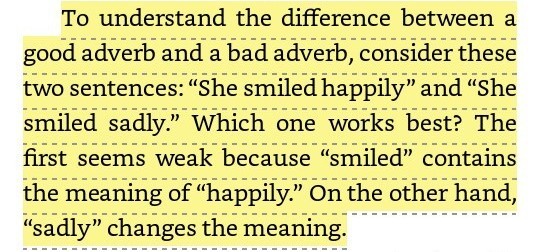
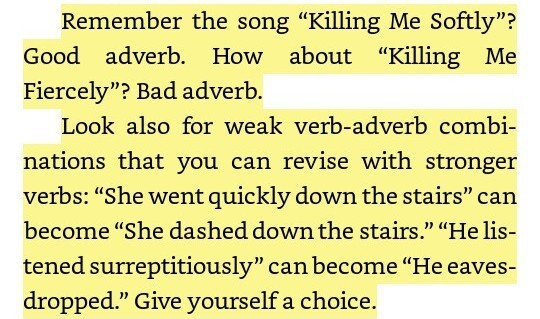
Verbs are your volume (said, shouted, shrieked), but adverbs change the pitch (gruffly, hoarsely, delightedly).
No one especially not a writing aid website is going to convince me that adverbs and passive voice are always bad. I mean, I can use passive voice to show a character’s lack of agency, or that they are apathetic. And I don’t see why it would be bad for a character to say “this will happen eventually” or “he looked fine physically”. and there are a lot of other situations in which using those things is probably okay.
WHY DID NO ONE TELL ME ABOUT PRO WRITING AID BEFORE?! THIS THING IS FUCKING GLORIOUS. HOLY SHIT. LOOK AT THIS.
IT GIVES YOU A WHOLE DAMN REPORT ON YOUR WRITING AND WALKS YOU THROUGH HOW TO MAKE IT BETTER AND WHY IT IS SUGGESTING CHANGES. THIS IS JUST A TINY CHUNK OF THE HUGE REPORT IT GAVE ME ON THE FIRST CHAPTER OF ONE OF MY PROJECTS. I AM IN LOVE.
AND IT WORKS WITH SCRIVENER. AND IT IS AFFORDABLE.
WHY DID NO ONE TELL ME?!
Seriously, a couple hours with this and my first chapter is so much better. It helped me see problems I KNEW I had (passive voice, showing vs. telling, adverbs) but was having a hard time sussing out. It has made editing so much more fun and easy because now I know what the hell I’m doing and what to look for instead of stumbling around blind shouting “adverbs? adverbs?” like a town crier. I can already tell I’m getting better at seeing things without the program having to show me too.
u wanna write a single, passing line of dialogue so u fact check it to make sure it’s historically accurate, then suddenly you’ve lost track of time, space,, urself
for instance: I wanted to know how frequently fighter planes were used in WWI and now I’m several pages deep into the history of witchcraft in ireland
I find it kinda odd how people talk about writing “flawed” characters like the flaws are an afterthought
Like “cool cool we’ve got this perfect hero now to just sprinkle on some Irritability and Trust Issues then microwave for 6 minutes on high until Done”
But I’ve personally found it feels a lot more useful to just… think of the flaws as the Good Traits except bad this time
The protagonist is loyal? Maybe that means they have a hard time recognizing toxic relationships and are easily manipulated by those they want to trust
The hero is compassionate? Maybe they work too hard and overextend themselves trying to help people and then they refuse to ask for help when they need it themselves for fear of burdening others
They’re dedicated to their ideals? Maybe they’re also too stubborn to know when to quit and they have trouble apologizing for their mistakes
If they’re creative, they can also be flighty. If they’re confident, they can be arrogant. If they’re brave, they might be reckless. If they’re smart, they could be condescending. Protective can become controlling, and someone who’s carefree could very well also be emotionally distant
In my opinion, the best “flaws” aren’t just added on afterwards. The best flaws are baked in deep, ‘cause they’re really just virtues turned upside down
I see a lot of writing advice, particularly about giving characters flaws. The main advice is “everyone has flaws! make sure to give your character flaws or else it’s not realistic!” And after thinking about it… I would like to challenge this.
It essentially posits a view of human nature that there are good and bad traits, and that these traits can be neatly diagrammed into separate columns, one set of which can and should be eliminated. It tends to go along with a view that posits character development should be about scrubbing away of “flawed” traits until the character achieves more a higher level of goodness, or else the character doesn’t and falls into tragedy. This is not untrue, necessarily. There are definitely some “flaws” that are 100% bad and sometimes a good arc is about slowly losing them. However, I could call this advice incomplete.
Consider thinking about it this way. Characters have traits and often whether or not that trait is a flaw is purely circumstantial.
For instance, fairy tales I read as a child. In some, when an old beggar asked for money on the road, it was a secret test of character. The prince who gave the old man money or food would be rewarded. But in other folktales I read, the old beggar would be malevolent, and any prince who stooped to help him would be beaten, punished for letting his guard down. Now, in a story as well as in real life, either of these scenarios can occur–a stranger who asks for help can be benevolent or malevolent. So which is the flaw? Is it a “flaw” to be compassionate? or is it a “flaw” to be guarded?
Trick question–it’s purely conditional. Both traits are simultaneously a strength and a weakness. Either has an advantage, but either comes with a price as well. And whether the price is greater than the advantage depends on circumstance. The same can be said for most character traits, in fact!
An agreeable character who gets along with everyone will be pressured into agreeing with something atrocious because it’s a commonly held viewpoint. A character who’s principled and holds firm even under great pressure will take much, much longer to change their mind when they are actually in the wrong. A character who loves animals and loves to shower them with affection will get bitten if they try the same on every animal. As the circumstances change, flaws become strengths, and strengths become weaknesses. And even a trait that’s wholly virtuous, such as compassion, comes with a price and can be turned for the worst.
You don’t have to think about inserting flaws into your character. Your character, even the most perfect “Mary Sue,” is already flawed the moment you give her any traits at all. The problem with Mary Sue isn’t a lack of flaws, it’s a lack of circumstances to challenge her properly, to show her paying the natural price. Your job as an author is to create circumstances in the narrative that 1) justify why these traits exist in your character 2) show what your character gains from these traits and then 3) change the circumstances to challenge her.
Make your character pay the price for their traits, for their choices. And then, when challenged, you can make a hell of a story by showing us how they adapt, or why they stick to their guns anyway.
this is well said. there is no such thing as a mary sue character, really, only a mary sue story. when every other character and circumstance revolves completely around the protagonist, that protagonist becomes a mary sue, no matter how ‘flawed’ they are. when the story is true to its own momentum and consequences, and the other characters are complex and have their own motivation, even the most perfect character can’t be a mary sue.
a mary sue isn’t a ‘perfect’ character, it’s a black hole that eats the story.
Sometimes writing is like: The forest arched high an impassable over her head, thickets thatched tightly together as if to keep her out. Even the trees seemed more foreboding, hollowed and bare, wind whistling ominously through their empty branches like a long-forgotten song.
And sometimes it’s like: The forest was filled with trees. It also had bushes. Ugly bushes. it was spooky.
I think I’m always chasing that particular high you only get from certain rare stories – the ones that resonate with you on a strange personal level, like an implacable aroma that reminds you of something that was once very dear to you but has somehow been forgotten. Those stories that rewire your brain just a little, just for a while. Not every great story has this effect – I have enjoyed many excellent books and movies that did not change me.
It’s just that now and then, if you’re very lucky, you’ll come across a story that feels like home, or a like limb you didn’t even know you had or how you got by all these years without using it. These stories haunt you and become part of your personal canon.
Of course, the real way to tell whether you’re in a Hard SF novel is if people keep providing you with unsolicited explanations of basic physics and everyday technology which you should, by rights, already know.
So every single woman is in a Hard SF novel is what you’re telling me
…You know, it’s occurred to me that this would actually be a very good way to do exposition in hard SF novels without needing anyone to break character.


 radiantanor.home.blog