
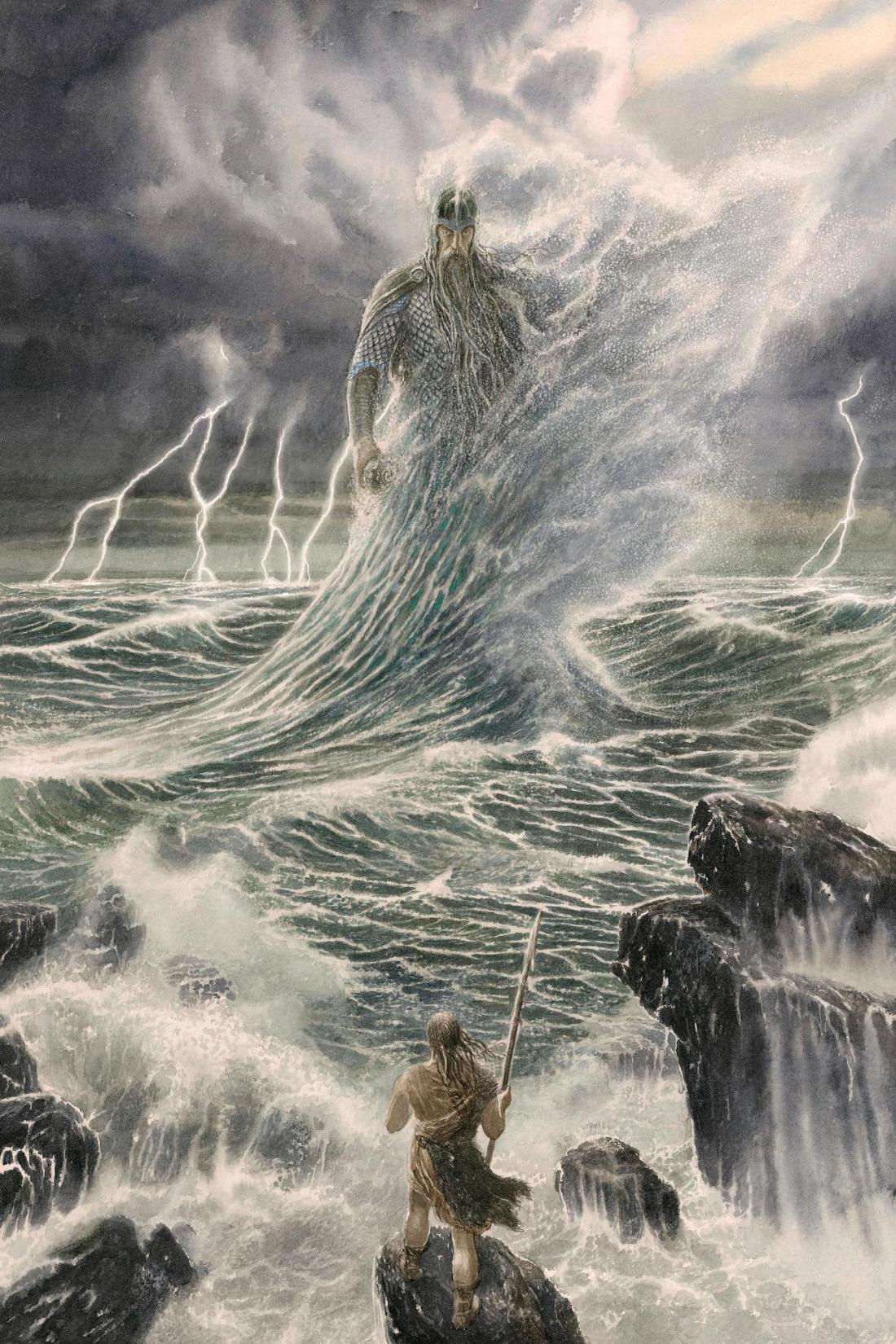
Ulmo and Tuor | Artwork by Alan Lee for The Fall of Gondolin | 2018

Another dip into watercolor after inktober. I have been wanting to do interpretations of Tolkien’s Valar, and Yavanna was up first! This was fun and very nearly meditative to do. 🙂


Vána and Oromë requested by @bluebirdflies and Oromë by @glorfinrod!
I had a lot of fun making up their design! For some reason, I just can’t imagine Oromë without the antlers! Thank you for the request; hope you like them!

Oromë and Nahar
So, I’ve been playing around with the concept that the Ainur really didn’t know a whole lot about the appearance of the Children of Ilúvatar outside what they glimpsed in the Music, as evidenced when Aulë created the dwarves. Reminiscent of a human/elven design, but not quite… accurate. Well, at least not completely accurate. As such, I like to imagine that in baited anticipation of the Children, each Ainur took on the shape of what they personally believed the Children would be like–influenced by their own interests and perspective. This is why the elves were so afraid of Oromë when they first met. It wasn’t just Morgoth torturing the elves and making them afraid of the Ainur, or the Ainur being giant god-like creatures. It was probably also because the Ainur didn’t have a full grasp on human/elven appearance, and the elves were like “Nope Nope Nope”

Inktober 2018
27.) ThunderAngry Manwe is scary Manwe.
Past Inktober Arts | <old to new> | <new to old>

More Silmarillion art, this time it’s Varda crafting a star. I love the idea of her hair being a literal nebula.
It’s hard to make the case that The Hobbit and The Lord of the Rings exhibit anything remotely approximating gender equality, but as a feminist Tolkien fan and scholar, whenever I bring up the sexist leanings of Tolkien’s writings, the first rebuttal I usually hear begins with, “But The Silmarillion …”
The Silmarillion is often held up by Tolkien fans as redemptive of the boys-only club he establishes in his better-known books and proof that he really wasn’t that sexist. After all, it includes competent, kick-ass female characters like Haleth, Lúthien, and Morwen. And then there are the Valar. The women of the Valar—the Valier, as they are called in the Valaquenta—don’t just watch the men do the work, bring them tea, and rub their shoulders at the end of a hard day. Varda and Yavanna are high achievers, creating the stars and the Two Trees, respectively, and of Varda we are told, “Of all the Great Ones who dwell in this world the Elves hold Varda most in reverence and love.”1 Nienna, too, is counted among the Aratar, or most powerful of the Valar, and was a mentor to Olórin, who used her teachings to help the people of Middle-earth win the Ring War.2 Surely, these women serve as proof of gender equality in The Silmarillion and Middle-earth in general, don’t they?
Yet only about 18% of named characters in The Silmarillion are women.3 The Valar are an interesting case study of the issue, however, since they occupy a prototypical and highly influential role over the other peoples of Arda and present a veneer of equality that becomes much more complex the deeper you dig.
On Prototypes and Cultural Influences: Or Why the Valar Matter So Much
The Valar present a unique case when looking at gender [in]equality in The Silmarillion. The Valar are the greatest of the Ainur, and we are told of Ilúvatar that “he made first the Ainur, the Holy Ones, that were the offspring of his thought, and they were with him before aught else was made.”4 The Ainur are the only creations of Ilúvatar that we get to see that have been subject to no subcreative or cultural influences outside of Ilúvatar. (Elves and Mortals are likewise “Children of Ilúvatar” but are culturally influenced after their creation by the Ainur, as I will discuss below.) The Ainur, therefore, are the best example we have of Ilúvatar’s pure, unadulterated vision.


 radiantanor.home.blog