I’ve been making jewelry for a number of years now. Pretty early on I was directed to a company called Fire Mountain Gems as a potential supplier. They sent a copy of their catalog with my first order, which introduced me to a *lot* of stones I’d never heard of… more than a few of which had trade names.
Now, understand, humanity has only relatively recently become fussy about how accurately they name their stones. For a big stretch of history, if it was reasonably hard and red OR dark red OR black with red highlights when you tilted it right, they’d probably call it a ruby. (Example: the Black Prince’s Ruby in the state crown of England, which is a completely different gemstone called a spinel, but they named it before the 1780s which is when we started being able to actually identify rubies as rubies. So… yeah.) Some kinds of gem have had lots and lots of different names all historically referring to the same stone. It makes for interesting reading of historic accounts of this or that piece of jewelry. I can excuse it, it was the past, really formal gemology is only a moderately recent thing.
But these days I go to the store and I see yellow gemmy-looking beads hanging on the rack, and I look at the sticker, and it says ‘yellow jade’, only the price is way less than that much actual jade would cost online. Or I go to look for smaller beads to match a few pieces of actual turquoise that I have on hand, and I realize that I have no idea whether African turquoise is actually turquoise or not. It gets… irritating. I want to actually know what the hell I’m paying for and whether it’s hard enough to risk putting it in a bracelet or ring, or whether it’s a softer stone that should be kept in earrings and necklaces, away from possible scratching or impact. If you’re buying jewelry, or if you’re looking for stones for jewelry work, or if you’re someone who believes in the metaphysical properties of stones and crystals, you’re going to want an accurate understanding of whatever it is you’ve got in front of you, right? Right.
So, yeah. Here’s a few of the trade names I’ve been stumbling over since I got started in jewelry making.
New jade – This is serpentine. It’s a pretty rock but it’s not jadeite or nephrite; it’s not actually jade. Serpentine’s way common, since it’s basically a form of one of the most common minerals in the earth’s crust.
Ching Hai jade – Dolomite plus a couple of other minerals. Pretty, but not jade. Let me put it like this: on the Mohs scale of mineral hardness, nephrite jade is 6 to 6.5 and jadeite is 6.5 to 7. Ching Hai jade is 3.5 to 4. This stuff is softer than the outer coating of human teeth (Mohs 5, same as a basic knife blade and most kinds of everyday glass). You want a stone you can put in a ring where it’ll get whacked or bounced off hard surfaces or otherwise stand a chance of impact, you’re gonna want real jade. Ching Hai jade will get scratched clear to kingdom come with a Mohs score like that.
Yellow jade – It’s quartz. Nephrite jade comes in a lot of colors including yellow, but if they’ve labeled it ‘yellow jade’ rather than saying ‘jade’ or ‘nephrite jade’ then it’s quartz. Same deal for ‘golden jade’.
Malaysia jade – Also quartz.
African jade – yep, still quartz.
Black jade – Both nephrite and jadeite come in black forms, but if a stone is being sold with the name ‘black jade’, it’s 90% likely to be serpentine. Actual jade gets labeled as jadeite or nephrite. I don’t do metaphysical stone foo, but man, if you’re buying a stone because you want to use its mojo, seems to me you’d want to get the actual stone associated with what you’re trying to do, not a stone that’s the same color and level of shiny.
Peace jade – Serpentine plus white quartz. I don’t even know where they came up with this name. It’s pretty but it’s jade the way a pommel horse is a horse.
Yellow turquoise – Serpentine again. Or rather, serpentine and quartz. At least this stuff comes from the same mines as turquoise.
African turquoise – Jasper. It’s turquoise colored, but it’s actually harder than real turquoise, for whatever that’s worth.
Italian onyx – They also call this one onyx marble. It’s a kind of calcite. Takes dye really well so they use it in different color forms.
African bloodstone / Indian bloodstone – Legit name for the actual stone, for once! These are both names for the same thing. They also call it heliotrope. So any of those names all refer to the same thing.
Tigerskin jasper – And we’re back to the malarkey; this is limestone. With pretty stripes, but seriously, it’s not even jasper and jasper gets used as a substitute for other stones so wtf.
Aqua terra jasper – Onyx marble. They also call it impression stone, but it’s marble, and it’s on the soft side as stones go. Marble’s around Mohs 3 on a good day. That’s another stone you can scratch with your teeth.
Green Earth jasper – NOPE. Serpentine. Sorry.
Peridot jasper – Serpentine. Seriously, do you have any idea how many stones with pretty pretty names are actually just pretty pretty names for different colors of serpentine?
Zebra jasper – onyx marble.
Chinese chrysoprase- Oh look it’s serpentine again
Lemon chrysoprase – This is magnesite. Not dyed, which is a little unusual. Magnesite takes dye really well and gets sold in a lot of colors as a substitute for other stones. Selling it as lemon chrysoprase means someone managed to get hold of a yellowish color of the stuff.
Mosaic turquoise – If it’s labeled mosaic anything, it’s almost always fragments of a stone bound together with resin, and probably not even the stone it claims to be. Mosaic turquoise is ittybitty chips of magnesite that’s been dyed to match turquoise color, then stabilized together as a single piece. It’s not even close to being turquoise.
Green opal – okay, quick lesson: there are different kinds of opal, and not all of them have the flashy color changing fire you get with precious stones like Welo opal or Australian opal. Mexican fire opal and Oregon fire opal are good examples of other forms. The actual stone we call opal is a specific kind of silica with a certain level of water content, not just the pretty flashiness. And opals of both the flashy kind and the non-flashy kind do come in green. But if they’re selling it as ‘green opal’, they are selling you chalcedony. Chemically similar, but not as pretty, and a distinctly harder stone.
Red malachite – This is marble. They find marble with banding that resembles malachite banding and they cut it and polish it to look like malachite, just in a different color. Malachite is green; this isn’t even a thing like jade coming in different colors. There isn’t actual red malachite.
Opaline – this isn’t even a stone. This is glass. Same deal with ‘sea opal’. Sorry. Sometimes they sell chalcedony as opaline but whatever it is you’ve found it’s not opal.
Fused quartz – Glass. This is glass. Fancypants glass, but it’s glass.
Goldstone, or blue goldstone: Also glass. With bits of copper in it to produce really nice sparkly effects, but it’s still a kind of glass.
Sand stone or blue sand stone: I only found out recently that some people sell goldstone as ‘sandstone’, so… this one’s glass too. Actual sandstone is a sorta brown sedimentary rock.
Black moss quartz – This is glass. Worth noting, there’s a vaguely similar product out there called rutilated quartz. That’s actual quartz with spindly intrusions of a different mineral, rutile. Difference is, the quartz has a Mohs hardness of 7 and will scratch the ‘black moss quartz’s’ soft bitch ass six ways from Sunday as a result.
Fordite – This is paint. Fordite is automotive enamel that’s dripped onto the same spot on factory floors for so many years that it’s built up to the point where it can be cut and polished and made into jewelry elements. Unlike a lot of trade names, this one isn’t a form of bullshit to pass one thing off as another. People who go looking for fordite are specifically looking for gemstone quality layered automobile paint. Sometimes they call it Detroit agate or motor agate, but that’s more of a joke than an attempt to sell the stuff to people looking for actual agate. I can live with this trade name.
Rainbow calsilica: Apparently there’s just a huge amount of argument about this and some people say ‘this is natural and we found it and it’s got pretty pretty stripes of all different colors just naturally and it’s a totally awesome metaphysical marvel of a totally natural gemstone’, but the Journal of the Gemological Institute of America says ’dude, you powdered carbonated rock and added paint and stabilized it with resin, wtf’. So yeah, be warned. I mean, it’s pretty and all, and you’ll probably pay way less for it than for chrysocolla (a natural stone with somewhat similar striping), but… be aware it’s probably something a guy in a factory or a lab put together, okay?
And citrine: Okay, this isn’t exactly a case of trade name bullshittery, but, uh. Natural citrine is stupid rare. Most citrine these days used to be amethyst. Take a crappy piece of amethyst with faint color or gray tones and heat the hell out of it long enough, and it turns yellow, and you can legally sell it as citrine. If you’ve got citrine crystals and the yellow color is most intense up in the tips, you’ve almost certainly got former amethyst there. Fair warning.
So… yeah. Lot of trade names out there. Some of them total bupkis. Some only partly so. Heads up, and if you’re in the market for a gem or a crystal or something like that, do yourself a favor and look up the name somewhere reliable first just so you know what you’re buying.
Here are some useful resources I’ve found while I’ve been in the community, so I thought I’d share! PLEASE ADD YOUR OWN IF YOU HAVE ANY! And please reblog and share!
References
askmiddlearth – A great blog where you can send in questions and receive answers regarding just about any aspect of the Legendarium.
coco.raceme – A collection of quotes, songs, and important passages from The Hobbit and The Lord of the Rings, arranged by book and chapter.
Fish in Middle Earth – Did you ever want to know what kinds of fish there were in Middle Earth? No? You’ll probably end up reading this anyways. The curiosity will get to you.
henneth-annun – The HASA story archive has mostly moved to AO3 now, but this website still contains hundreds of timelines, character bios, quotes, object descriptions, and more.
silmarillionwritersguild – Essays, meta, biographies, and more – all about the plot and characters of the Silmarillion.
Languages
almare – Tumblr user almare has a great collection of Tolkien language resources, including a handy graphic of the relations between Elvish languages.
councilofelrond – A good resource for translations of canon texts, glossaries, conlang discussions, a dictionary, etc. Of particular interest is their Sindarin mutation chart, which is necessary pretty much whenever you’re stringing more than two Sindarin words together.
Hiswelókë’s – A delightfully thorough dictionary available in a variety of arrangements ( English-Sindarin, Sindarin-English, thematic, etc. ). Available in English, French, and German.
midgardsmal – The blog of David Salo, one of the people who worked on the languages in Peter Jackson’s Tolkien films.
realelvish – A handy phrasebook that provides categories for easy searches, dialects, pronunciation, and multiple translations of the same phrase. Includes fun categories, such as ‘in the bedroom’ and ‘on the internet’, as well as many others that are more in keeping with Tolkien’s tone.
sindarinlessons – A collection of rules, references, and explanations of Sindarin grammar.
your-sindarin-textbook – On this site, a duck teaches you Sindarin. What more could you want? Includes exercises and references.
Books
All the books in PDF – These two posts both contain links to Tolkien’s works and where you can find them online.
HoME reading order – tumblr user lintamande has put together a list of Tolkien’s texts beyond the Silmarillion, in case you were wanting to dip your toes into HoME but didn’t know where to begin. They also have a general Silm resource page that’s worth looking at, as well as all their meta.
Tolkien’s letters – A collection of many of Tolkien’s transcribed letters, useful for all those really obscure facts you need to check and to impress your friends.
Non-Tolkien
A shameless plug– I do my best to collect useful references, notes, and masterposts on writing, Tolkien, and more in my ‘references’ tag.
howtofightwrite– This blog contains discussions on weapons and how they’re used, as well as some particularly useful weapon primers that will give you the basics on the weapons your character uses.
Medieval references – A collection of a few useful references for medieval-type jobs, terms, and more.
Mood music – Themed music playlists for just about anything you could ever want to write.
Traveling – The methods of traveling in the Middle Ages, and the time it would require.
Adding links for the Lord of the Rings Family Project, which has the best set of genealogies hands down and I constantly reference it.
Ardalambion is a high quality language resource and has extensive wordlists. Good for obscure languages like Nandorin and Taliska. It’s more in-depth than a dictionary and has notes on in-universe and out-universe history for the languages.
Textual Ghosts Project, a list of unnamed and missing female characters from Tolkien’s works.
Notes: some of the book links don’t work any more.
The working link for OP’s resources tag is now here.
This is really useful! Thanks to OP for collecting these! (I totally looked at the fish essay.)
There is some good stuff here. I’d add to it though that if you want books ABOUT Tolkien, Tom Shippey is well worth a read: particularly The Road to Middle-earth: How J. R. R. Tolkien Created a New Mythology and J. R. R. Tolkien: Author of the Century.
Shippey is not just a biographer, like Humphrey Carpenter, he is a fan, and a major expert in Old English and Medieval writing, so he really understands Tolkien on a level that I don’t think many people who write about him do. Furthermore, the man can write truly entertainingly and absolutely isn’t the least bit embarrassed about being a fan of a ‘genre writer’.
(Please buy or borrow his books properly from a library so he gets paid for them: don’t pirate them!)
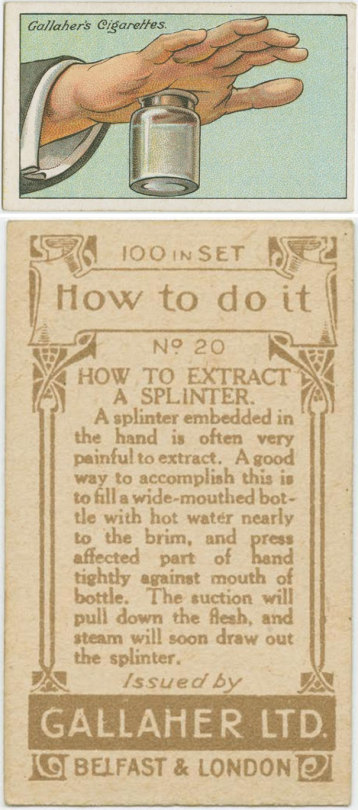
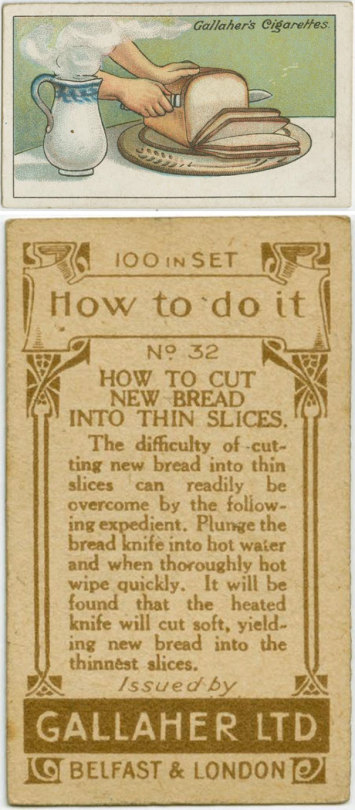
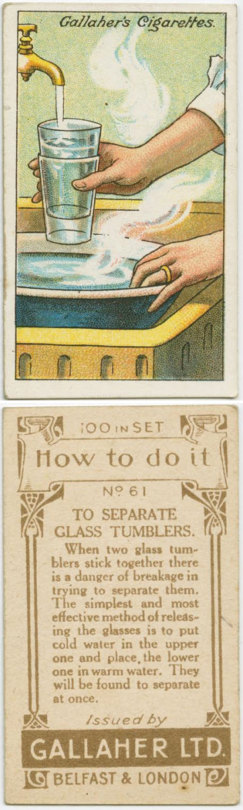
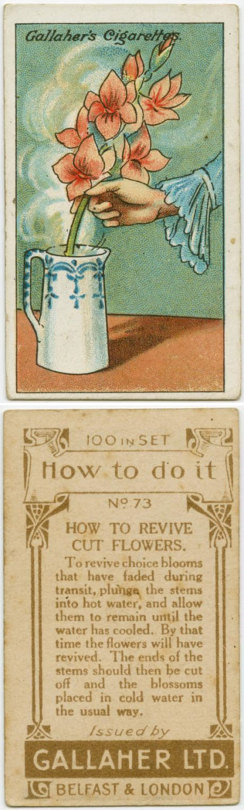
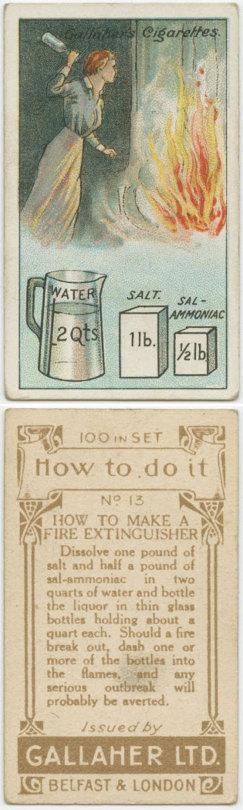
People don’t often look back on the early 1900’s for advice, but what if we could actually learn something from the Lost Generation? The New York Public Library has digitized 100 “how to do it” cards found in cigarette boxes over 100 years ago, and the tips they give are so practical that millennials reading this might want to take notes.
Back in the day, cigarette cards were popular collectibles included in every pack, and displayed photos of celebrities, advertisements, and more. Gallaher cigarettes, a UK-founded tobacco company that was once the largest in the world, decided to print a series of helpful how-to’s on their cards, which ranged from mundane tasks (boiling potatoes) to unlikely scenarios (stopping a runaway horse). Most of them are insanely clever, though, like how to make a fire extinguisher at home. Who even knew you could do that?
The entire set of life hacks is now part of the NYPL’s George Arents Collection. Check out some of the cleverest ones we could find below. You never know when you’ll have to clean real lace!
So, pretty frequently writers screw up when they write about injuries. People are clonked over the head, pass out for hours, and wake up with just a headache… Eragon breaks his wrist and it’s just fine within days… Wounds heal with nary a scar, ever…
I’m aiming to fix that.
Here are over 100 links covering just about every facet of traumatic injuries (physical, psychological, long-term), focusing mainly on burns, concussions, fractures, and lacerations. Now you can beat up your characters properly!
Wound assessment: A huge amount of information, including what the color of the flesh indicates, different kinds of things that ooze from a wound, and so much more.
Location pain chart: Originally intended for tattoo pain, but pretty accurate for cuts
General note: Deeper=more serious. Elevate wounded limb so that gravity draws blood towards heart. Scalp wounds also bleed a lot but tend to be superficial. If it’s dirty, risk infection. If it hits the digestive system and you don’t die immediately, infection’ll probably kill you. Don’t forget the possibility of tetanus! If a wound is positioned such that movement would cause the wound to gape open (i.e. horizontally across the knee) it’s harder to keep it closed and may take longer for it to heal.
General notes: If it’s a compound fracture (bone poking through) good luck fixing it on your own. If the bone is in multiple pieces, surgery is necessary to fix it–probably can’t reduce (“set”) it from the outside. Older people heal more slowly. It’s possible for bones to “heal” crooked and cause long-term problems and joint pain. Consider damage to nearby nerves, muscle, and blood vessels.
General notes: If you pass out, even for a few seconds, it’s serious. If you have multiple concussions over a lifetime, they will be progressively more serious. Symptoms can linger for a long time.
Dislocations: Symptoms 1, 2; treatment. General notes: Repeated dislocations of same joint may lead to permanent tissue damage and may cause or be symptomatic of weakened ligaments. Docs recommend against trying to reduce (put back) dislocated joint on your own, though information about how to do it is easily found online.
Guys, this is really important. Until now, Google collected your data, but did not attach your name to it. Now, they can, and will. This new thing they’re doing will allow them to collect your data across searches, your email, Youtube, Maps, Google+, and all their affiliates, and build a complete profile of YOU.
If that doesn’t bother you, maybe this will: they own and can sell all that data, including anything you create and send (artists and writers, take note).
There is a way you can opt out of this ridiculousness. It’s described in the link, but if you’re still not sure about it, please ask me and I’ll guide you through how to turn all this off.
This is my wake-up call. I’ll be locking down my devices and scaling back what I put through the big Google machine, which means you may see less of me across social media. I’m going to keep researching this, but it may mean in order to keep the rights to my creative work, I’ll have to keep it out of Google’s hands. And that may take some doing.
Duckduckgo is a nontracking search engine….may be worth a try.
So according to the article there is an opt out for this. Instructions are I the last paragraph. I’m on mobile so I’ll edit this more later. EDITED TO INCLUDE OPT OUT INSTRUCTIONS
To opt-out of Google’s identified tracking, visit the Activity controls on Google’s My Account page, and uncheck the box next to “Include Chrome browsing history and activity from websites and apps that use Google services.“ You can also delete past activity from your account.



 radiantanor.home.blog


