This is a humble post on some castle and fortification architectural terms – specifically, walls. When writing, sometimes I cannot find the right word for a… *flails hands* thing, and I like to be accurate, when possible. This is notThe Definitive Post on Castle Architecture. I’m sure someone else has made such a thing and they deserve applause.
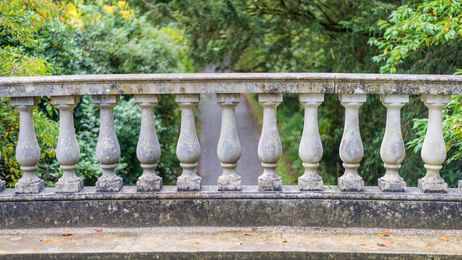
A balustrade is a railing piece along a bridge, stair or balcony. It is supported by balusters, which are short, typically decorative columns. Balustrade may also refer to the entire column/railing construction. Balusters along a stairway are often called bannisters.
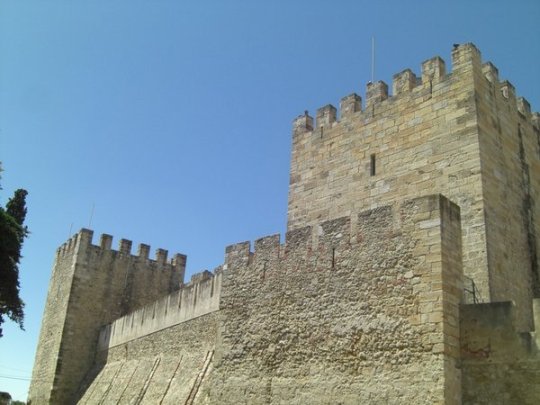
A parapet is a short, protective barrier, usually no more than head-height, along a terrace, balcony or roof. When a parapet is crenellated, meaning it has indentations at regular intervals, it is called a battlement. The gaps in a battlement are called crenels or embrasures; the solid upright sections (the not-gaps) of a battlement are called merlons.
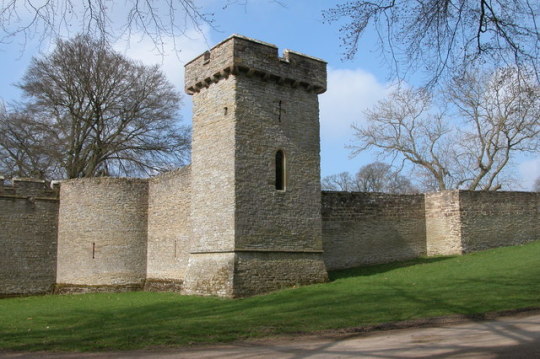
A bulwark is any kind of defensive wall or embankment. A bastion is a structure projected outward from a castle or fortification. The connecting wall between bastions or towers is a curtain wall.
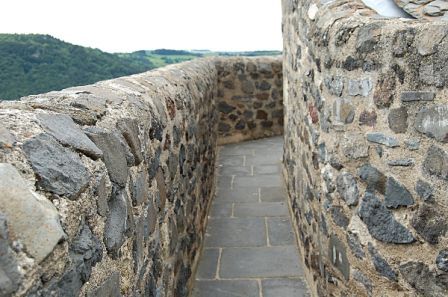
A rampart is a thick defensive wall with a broad top, which is often crowned with a parapet or battlement. A chemin de ronde is a protected walkway atop a rampart and behind a battlement, sometimes called a wall-walk if you don’t want to sound too fancy.
There are many more parts to castles and other fortifications. Explore them and enjoy. But if this helps anyone just a little, I will be pleased.
Adele aus der Ohe (1861-1937) from Germany 📚 Wikipedia🎵IMSLP She studied with Franz Liszt. She was friends with and performed Tchaikovsky’s First Piano Concerto with him conducting.
Rebacca Clarke (1886-1879) from England 📚Wikipedia🎵IMSLP🌀Rebecca Clarke.org (I have access to almost all her published works, let me know if you want me to email scans of something to you)
She studied with Lionel Tertis and briefly sang under Vaughan Williams. In 1919 her Viola Sonata tied in the Berkshire Festival of Chamber Music with Ernest Bloch’s Viola Sonata. She was also friends with Frank Bridge. In 1912 she was one of the 6 female musicians allowed into the Queen’s Hall Orchestra (later became the LSO)
Florence Price (1887-1953) from the USA 📚 Wikipedia🎵 IMSLP She began studying at the New England Conservatory after she graduated high school at 14. The Chicago Symphony Orchestra premiered her Symphony No 1 in E minor on June 15, 1933, making Price’s piece the first composition by an African-American woman to be played by a major orchestra
Lili Boulanger (1893-1918) from France 📚 Wikipedia🎵 IMSLP She was the first woman to win the Prix de Rome when she was only 19, in 1912.
To randomly continue the gemstone-educating trend I seem to have going, this is what I mean by there not actually being much difference between stones that are not emeralds in the lab-created vs. natural argument.
First, the ruby:
Without being told, how would you know which one is real and which one isn’t? (It’s the bottom image, by the way.) When it comes to lab-created rubies, they even manage to get the color variances correct within the stone. Both of these are predominantly a pink-tinged red with swirls of purple-y magenta in there.
Blue Sapphires are a bit easier to tell the difference:
This is a natural AAA-grade blue Burmese Sapphire:
And this is a synthetic blue sapphire:
The only hint you’ll have with lab-created sapphires is that, like an emerald, they’re too perfect. No occlusions. Now, good sapphires can have no occlusions and be perfectly cut in nature, but lab-growns will all be rather uniformly perfect and there will be very few variances in color–because natural blue sapphire tend not to have those variances except in odd instances. (Example: My dark blue sapphire was right up against a pyrite vein when it was harvested, so it has sprinkles of pyrite hiding in the stone if you look through it with good light and a jeweler’s eye. Sometimes you can even see them with light alone.) T
he Burmese example above helps to convince you it’s real in the way that it reflects light in different colors–note the pale violet. The synthetic is TRYING to do that, but it only ever manages a dark purple that’s still very close to being that same shade of blue. (There is a difference in cut between these two stones that makes the natural one reflect light more easily, but it would be behaving the same, regardless.)
However, once you get to the really DARK sapphires? You’re going to have a lot more trouble, like so:
Is it real? Is it lab-grown? I don’t even fucking know because the site didn’t say.
Basically when it comes to lab-created stones or natural gemstones, the best thing you can do is buy from a jeweler who has an excellent reputation or from a seller of the gemstones by themselves who has a perfect rating. Or get a degree in gemology.
OTHER IMPORTANT TERMINOLOGY:
Synthetic = cheap piece of shit. Synthetic gemstones are not lab-grown. (They’re most often faceted glass, but “synthetic” sounds better than “costume jewelry.”)
Lab-grown or Lab-created = chemically composed of the same material of the natural gemstone. If you can’t afford the real gemstone when it comes to a good sapphire or a ruby, lab-grown or lab-created stones are just as nice.
Just don’t buy a lab-created emerald. Don’t spend that kind of money when you can just get a nice, natural green beryl and have the same color and style of stone for much cheaper.






 radiantanor.home.blog