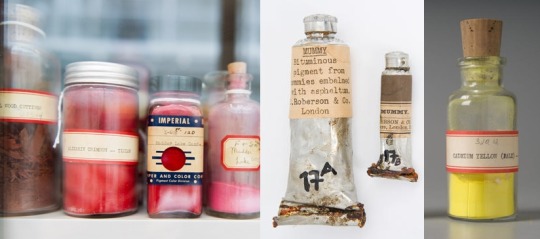
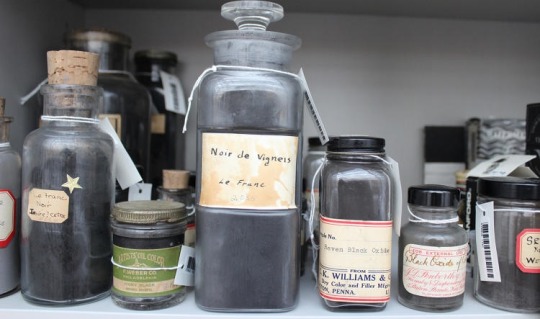
Harvard has a pigment library that
stores old pigment sources, like the
ground shells of now-extinct insects,
poisonous metals, and wrappings from
Egyptian mummies, to preserve the
origins of the world’s rarest colors.
A few centuries ago, finding a specific color might have meant trekking across the globe to a mineral deposit in the middle of Afghanistan. “Every pigment has its own story,” Narayan Khandekar, the caretaker of the pigment collection, told Fastcodesign. He also shared the stories of some of the most interesting pigments in the collection.
Mummy Brown
“People would harvest mummies from Egypt and then extract the brown resin material that was on the wrappings around the bodies and turn that into a pigment. It’s a very bizarre kind of pigment, I’ve got to say, but it was very popular in the 18th and 19th centuries.”
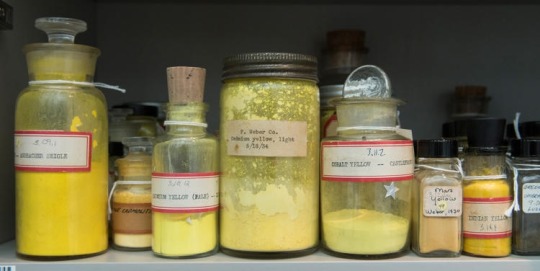
Cadmium Yellow
“Cadmium yellow was introduced in the mid 19th century. It’s a bright yellow that many impressionists used. Cadmium is a heavy metal, very toxic. In the early 20th century, cadmium red was introduced. You find these pigments used in industrial processes. Up until the 1970s, Lego bricks had cadmium pigment in them.”
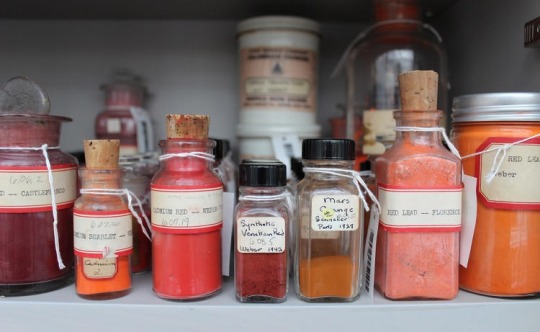
Annatto “The lipstick plant—a small tree, Bixa orellana, native to Central and South America—produces annatto, a natural orange dye. Seeds from the plant are contained in a pod surrounded with a bright red pulp. Currently, annatto is used to color butter, cheese, and cosmetics.”
Lapis Lazuli “People would mine it in Afghanistan, ship it across Europe, and it was more expensive than gold so it would have its own budget line on a commission.”
Dragon’s Blood “It has a great name, but it’s not from dragons. [The bright red pigment] is from the rattan palm.”
Cochineal “This red dye comes from squashed beetles, and it’s used in cosmetics and food.”
Emerald Green “This is made from copper acetoarsenite. We had a Van Gogh with a bright green background that was identified as emerald green. Pigments used for artists’ purposes can find their way into use in other areas as well. Emerald green was used as an insecticide, and you often see it on older wood that would be put into the ground, like railroad ties.”
say what you will about the Star Wars prequels but they both directly set up the central conflicts and character arcs of the original trilogy and they take all the characters that appear in both trilogies to recognizable and understandable places
there might be logistical problems or plot holes or bad filmmaking in places, but everything that happens in them has a purpose and helps build the story we’re already all familiar with. you can watch the original saga and see it as a coherent generational story – the nineteen-year time skip doesn’t leave a feeling of having missed vital information, but instead invites speculation without confusion.
one reason I think the sequel trilogy is so badly shaped and badly received by fans is because this sense of continuity is gone – rather than show us how things have changed and letting us pick up where we left off with Return of the Jedi, we’re plunged into a conflict we have no understanding of, with characters we’ve never met and have no context for. the original Star Wars did this and succeeded because it drew so heavily on familiar Western myths and archetypes, and because Luke was our audience surrogate and we got to experience the story and exposition with him, and because the story was fairly simplistic and everything was explained as the plot developed. the sequel trilogy fails because not only is there no established line of continuity between it and its predecessors, but where the characters we know were as of RotJ is not even close to where they are as of TFA. any and all development that might have grown out of their finished character arcs is scrapped in favor of reductive back-to-basics ideas about rehashing old stories, which confuses new audiences who might have foregone seeing the original films and leaves old fans wondering what the hell happened. not to mention the insistence that all non-movie elements of the property must be canonical – this leaves everyone uninterested in reading every single new novel without sometimes-vital characterization and backstory.
I showed this post to my boyfriend and he tried to take his shirt off like a girl and
uh
yeah
Out of the 82k notes my post got this is by far the best comment holy shit thank u for being u
So i tried it both ways and uh
i mean how do you do the first one without pulling out all your hair?
this made me laugh really hard….
and it made me realize that girls and boys pull their shirt off differently. /amazed
but seriously I think girls just do the cross arm thing because of HAIR like demonstrated
So one year, one URL change, and a hair cut later, I decide to try again… FOR SCIENCE!
Its not science unless you write it down so
First method:
Well done, i guess…
Second:
I fucked up
Girls… how?
I DON’T UNDERSTAND HOW WE CAN HAVE SUCH DIFFERENT WAYS OF TAKING OFF SHIRTS AND SO MUCH DIFFICULTY DOING IT THE OTHER WAY
I FIGURED IT OUT!!!!!
It’s all in the way that girl/boys shirts are made.
Girls shirts have less armpit room then boy’s do and are generally shorter so pulling it off over your head is more practical because by lifting your arms all the way up you make enough room for the sleeves to just slip off.
Boys shirts have more room and are generally longer so it is easy to slip them off over your head.
but if you take a girls shirt off like a boys shirt you will get your arms caught because there isn’t much armpit space.
and if you take a boys shirt off like a girls shit you will still have your head in it when you’ve lifted your arms all the way up because of the shirt’s length.
It has nothing to do with us. It is entirely to do with how our shirts are made. I figured it out for you. YOU’RE WELCOME!
bless you
look what is back on my dash. Jesus.
This came back but with ACTUAL SCIENCE you are the saviour of our generation























 radiantanor.home.blog