Honestly, when it comes to my own personal views? I believe that no one is beyond redemption (though whether or not the people said individual wronged are willing to forgive is wholly up to the people in question). For me, the belief that anyone can claw their way out of iniquity is not only a central tenet of my faith but also the knowledge that keeps me emotionally balanced and stops me from wallowing in bleak cynicism. I have to believe that redemption is possible for all, even if some choose not to take that road.
It always grinds my gears when people talk about redemption as if it’s something to be ‘deserved’, rather than an active choice, a verb, something a person does, with more or less variable degree of success. To redeem oneself is to take the necessary steps toward uplifting one’s soul from moral degradation. In essence, they keep equating redemption with something like forgiveness, when the two are entirely different matters and don’t have a 1:1 correlation at all. Some of my favourite redemption narratives (Anakin Skywalker lives AUs, for example) don’t really contain all that much in the way of forgiveness, because some acts simply can’t be forgiven by their victims. For me, the enjoyment of such stories comes from seeing the central character’s physical and emotional struggles with everything redemption entails, until they can achieve a weary, wizened peace with the world and with themselves. There’s an almost poetic beauty, I’ve always thought, to the words of a person who has walked in both the brightest light and the darkest shadow and it’s a real pleasure to put those sorts of words down on paper.
And yes, as I said before, I suspect that at least some of this nonsense comes from people having a visceral reaction to their own flaws being reflected back at them. For others, it’s your run-of-the-mill purity culture wankery.
I really like this for making a distinction between redemption and forgiveness. I am well on record as hating most forgiveness arcs. A lot of time, it feels like the character hasn’t earned it, but the narrative requires that their victims forgive, and I vomit inside my mouth a little. A redemption arc is just the opposite. By god, the character puts in the work. And at the end of the day, they may not be forgiven, but they do what they have to do, because they have to do it, because it’s the right thing to do. And that? That matters.
I…I recognize the joke, but these are totally different kinds of bows, each with its own benefits and suited to its user.
Bard’s using a longbow.
Longbows are awesome and take a fuckton of regular practice to use, because the muscle strain required to be a longbowman(/woman) actually deforms the arms and back of the user.
“Bard the Bowman” is still known by that sobriquet even though he’s low status, his family’s life and profession changed when the dragon attacked. Why would he be called that, if not that he’s still in regular practice and people see him using the thing over and over and over?
Longbows are less-damaged by damp than composites, being made of once single piece of wood rather than layers of material, which is handy if one lives in the middle of a freaking lake.
The longbow changed the face of warfare in real life, esp. for England. They’re effective killing machines over long distance, even against armored enemies.
Conclusion: Bard’s a tank-muscled distance shot used to fighting with good sightlines.
Legolas and Tauriel use recurve bows, albeit in different styles.
Legolas’ looks like a Turkish bow, though I don’t recall seeing him use a thumb draw (which is not mandatory if you’ve got super strong elf-fingers, I guess).
Tauriel’s looks to be a Scythian composite bow by the shape.
Composite recurve bows are much easier to use in confined spaces and at odd angles.
They have been historically used by folks who specialize in archer tricks like multiple arrow shots (a thing we have seen Legolas do).
Because of the curves, composites pack heavy draw weight (the factor that determines with what force, i.e. how fast and far, the arrow will travel) into limited space.
Short draw (the distance you have to pull back the arrow to shoot it) means a quicker release time and quicker time to get your next arrow on the string.
Legolas and Tauriel fight in a forest, not know for long sight lines or easy travel, nor for enemies who can be seen coming. They need weapons that won’t be getting caught on a bush at an inopportune time. Likewise, you see fewer spears and longswords among the elves of the Greenwood.
Conclusion: Legolas and Tauriel are guerrilla fighters from a heavily-forested territory and their weapons reflect that.
Kili also uses a composite recurve bow.
For practical purposes, note that Kili has significantly shorter arms than any of the other archers here mentioned. Long draws, like on Bard’s longbow, are not feasible and that means he’s not going to get the power he is capable of producing.
Dwarves are fucking strong, all right? That wee little bow looks very like the Mongolian horse-bow in size and shape that my friend used with a draw weight of 55 lbs. (I’m not a weakling and I can draw 35 for a decent length of time when in practice). Kili’s could easily be upwards of 75-100 lbs.
Kili’s a hunter. Likely, his main concern with a bow (when not following his uncle on an inadvisable quest) is the procurement of dinner for his family. To do that with a bow you need to be very quiet or very quick on the draw. Dwarves are not known for being super-quiet, though I believe I remember something about Fili and Kili being better at that than is typical.
Anything that can kill a deer can probably kill a person (or an orc). That little horse-bow can easily kill or maim.
Conclusion: Kili is a hunter. He uses a bow that allows for the production of a lot of power at short notice and is suited to his size and strength.
Bigger is not always most effective. Your medieval weaponry rant has concluded for the day, unless someone wants to talk to me about swords.
Partially inspired by this post of @actualmermaid‘s. Down with swan!Elwing, long live pelican!Elwing.
Practical considerations:
Swans are not seabirds- swan!Elwing would not have done terribly well flying from Sirion to the middle of the blasted ocean whereas pelican!Elwing could use her special drag-reducing low flying technique or just swim ragefully underwater
Pelicans are very large indeed, among the heaviest of all flying birds. Even a Vala must have some trouble with the law of conservation of mass, and elf->bird poses some definite dilemmas. Go for the largest bird possible!
Why dangle your Silmaril precariously off a scrawny little bird-neck when you could make a bird with a built-in Silmaril pocket
But if you really have to have the Silmaril hanging from the bird neck for ~ambience or w/e, pelicans are still superior. Swans fly with their neck parallel to the ground, making it very easy for a necklace-mounted Silmaril to slip tragically into the ocean, whereas pelicans fly with their heads practically resting on their bird shoulder blades, like a girl whose unnecessary male dance partner at the club has just tried to kiss her. Far more stable.
Pelwing
And lastly, this image:
Judgy black-and white sword bird, neck bag glowing with all the glory of the light of Aman: Plummets sword-first to the deck
Eärendil, struggling to “take into his bosom” an enraged 25 lb bird with a hallowed combination pike/satchel bag for a face: “It’s me wife!”
And lastly lastly, if you’re into that depressing symbolism, how about the pelican who pierces her own breast to feed her young, or sometimes kills them herself and revives them with her own blood and suffering. How about that, huh.
tfw you get Elwing Discourse adjacent material in your mentions and you wonder what’s going down this time
j/k, this is great
While this is an excellent argument, I would like to offer as a counter-argument albatross Elwing.
Albatrosses are exceptionally large birds, with wingspans of up to twelve feet. At twenty to twenty-five pounds, they offer as much or more advantage regarding conservation of mass as the pelican.
Their enormous wingspan is because albatrosses specialize in long-distance flights across open sea. They’re highly efficient in the air, using dynamic soaring and slope soaring to cover great distances (up to 1000 kilometers per day) with little exertion. Great for chasing your husband’s sailing ship across the vast western sea between Middle-earth and Valinor. In contrast, pelicans inhabit shoreline and inland waters, and their flight range is substantially shorter.
Look at that beauty. That’s a Southern Royal Albatross, appropriately regal for our Doriathrin princess.
They’re exceptionally long-lived birds; one albatross still alive today was banded in 1956 at the approximate age of five years, and is now the longest-lived wild bird known to science at the ripe old age of at least sixty-six. While obviously not the same as immortality, for a wild bird that’s a pretty impressively long lifespan.
While pelicans mate for a season, albatross pairs are monogamous for life. So even bird!Elwing would instinctively seek out her wandering mate.
The symbolism of the albatross is also delightfully on the nose. The Latin name, Diomedea, references the mythical metamorphosis of the companions of the Greek warrior Diomedes into birds, so we’ve got magical transformation right off the bat. Then there’s the tradition that albatrosses were the souls of lost mariners, also very apropos. And of course the classic “albatross around the neck” a la Coleridge signifying a burden that feels like a curse, both in terms of a literal burden and a psychological burden. So you have Elwing as both the metaphorical and literal albatross around the necks of Maedhros and Maglor, but also Elwing carrying her own ‘albatross’ in the form of the Silmaril.
my primary reaction to infinity war is like…. wow. under hypercapitalism we literally can’t imagine any other fables about resource scarcity, huh?
i’m not even talking about only thanos. every time thanos said his plan to kill half the galaxy (because it’s “finite,” lol ok one-semester-of-econ guy) the other characters were like “no!” or “you can’t!” or “that’s madness!” instead of… counter-arguing, or saying anything like “couldn’t you just… double the resources with a snap of your fingers?” obviously, nobody wants thanos to murder all those people, but it’s also as if everyone tacitly accepts his framing of the problem. “i want to kill half the universe because of resource scarcity,” he says, and everyone says “no, that’s too cruel!!” instead of “wait… wait just a fucking second there, paul ryan.” they don’t even have a line like that even when they’re talking amongst themselves, just musing at how twisted his worldview is, that he can only imagine infinite power as an infinite power to kill. no time is spent imagining an alternative.
and i can’t help but think about how we in the quote-unquote “first world” treat the resource consumption of the so-called “developing world.” we, who have enjoyed the pleasures and benefits of fridges and air conditioning and televisions and cars and convenience food and all that shit for generations: we look at the growing energy & plastics consumption of the developing world and go “uh oh, they’re really running the tab up over there, we can’t let this happen, think of the…. trees!!!” we have the audacity to act like people living in poverty in the tropics wanting window fans is selfish and short-sighted for the environment, and meanwhile we use and waste all the energy and resources we can get ahold of, like a continent full of montgomery burnses.
infinity war could have taken thanos’s approach to scarcity somewhere bigger: somewhere that was useful as a parable for our hypocrisy. the way that ragnarok was brave enough to make a parable of empire; the way that black panther could explore diaspora and identity; the way that the winter soldier actually had something to say about the surveillance-terror state. but for all the moving pieces of infinity war, i don’t think it knew where its central ethic rested. certainly, its characters showed the desire to preserve and protect life. but that’s true of any superhero film.
what it comes down to for me, is that it’s not enough for this movie’s theme to be “let’s protect people, because killing people is bad!” or even, sorry steve, “we don’t trade lives.” it’s not enough. thanos basically says, “there’s one bowl of soup and one spoon and two hungry people, so one of them has to die.” so what i needed was someone to openly reject that whole proposition. not just “no, you shouldn’t kill trillions,” but “no, that is fucking ludicrous, i reject that worldview. i reject human life as a brutal competition. group survival, even in the face of scarcity or hardship, is exactly what the fuck we developed culture for.” like, we could use that message. that message, delivered palatably in a blockbuster action movie, could do some good.
but it wasn’t really in there. maybe in little bits, in pieces. maybe. so i’m sure we’re going to have to endure a bunch of “welllll, thanos was a bad guy, but he did have a point about scarcity” metas. because we’re still failing to see how asking other people to die so that the rest can enjoy plenty is itself exactly the fucking problem on this bitch of an earth
i will acknowledge that gamora comes the closest to doing this. gamora comes down on thanos for slaughtering half her planet. but!! but! then thanos gets this horrible line about how the children who grew up after his genocide got to have “full bellies” and the planet’s a “utopia” now. and what does gamora get to say back to that? nothing! she doesn’t get a line after that! she looks angry and grief-stricken, but the writers don’t give her a single fucking thing to say in disagreement!! like, how about: “growing up as a traumatized survivor of genocide isn’t very fucking utopian????” the writers couldn’t imagine that fucking line?
I had someone tell me that dislike of Umbridge is usually from ingrained sexism toward female villains. I kind of stared in shock – I mean I love my lady villains. I love nasty female villains. I love sneaky and clever female villains. I love female villains that wrap themselves up in what the patriarchy expects of them and uses those expectations to smash someone upside the head.
I tried to explain my hatred of Umbridge isn’t that she’s full of traditionally feminine attributes.
It’s that she’s lawful evil.
If you did an alignment chart, no one would represent lawful evil more than Umbridge. I don’t think there’s ever been a character that better sums up lawful evil.
And, to me, lawful evil is the most terrifying and disturbing evil there is.
To me, lawful evil is the shit that gets thousands of people killed while the person responsible walks away feeling like they did their duty.
Evil forces like Bellatrix and Voldemort are fairy tales. They’re the bad guys a good guy can chase away with a sword or wand.
Umbridge is that evil that really does lurk in the hearts of men (and women). The realness, the plausibility of it, makes her amazingly uncomfortable.
So, yeah, I can’t get as excited about her as a fantasy book creation as easily as some other female villains. Not because she’s a woman, or because of her gender presentation, but because she represents a sort of evil that’s far, far too close to home.
What she means: I understand the Chronicles of Narnia was at its heart a fairytale with theological analogies for children. But why did Lewis never address how they had to adapted to life on Earth again. Why does no one talk about how the Pevensies had to grow up with a kingdom of responsibilities on their shoulders, only to return to Earth and be children. Take Lucy, she was youngest and perhaps she adapted more quickly-but she had the memories and mind of a grown woman in an adolescent body. Edmund literally found himself in Narnia, he went from a selfish boy to mature and experienced man. He found a purpose and identity through his experiences to come back as just Edmund, Peter’s younger brother. Did people wonder why the sullen, sour boy came back, carrying himself like a wisened king? Did his mother wonder why he and Peter suddenly got along so well, why they spent so much time together now? And Susan, the girl of logistics and reason came back with a difference in her. She learned how to be a diplomat and ambassador, Susan the Gentle had to live to endure not-so-gentle circumstances. She had the respect she wanted, only to be just another teen girl. And Peter, he entered the manhood and maturity he so wanted. He earned the responsibility and stripes he yearned for. He learned to command armies and conduct the menial tasks demanded of a king to rule a nation. But he came back, appearing to be just anther glory-hungry boy. Not to mention the PTSD they must have struggled with. Especially Edmund. How often did he wake up in a sweat, screaming a sibling or comrade’s name? His parents believe it’s the war, but it’s an entirely different one he has nightmares about. How often did he have trouble with flashbacks and mood swings? And how many times did he and Peter sit over a newspaper or near the radio listening to reports on the troops. How often did they pour over lost battles and debate better strategies. Did their parents ever wonder why they seemed to understand flight war so well? How long was it before they stopped discussing these things in front of people? Why does no one talk about this???
Why am i fucking crying
Why does no one talk about how the Pevensies had to grow up with a
kingdom of responsibilities on their shoulders, only to return to Earth
and be children
It’s not addressed because it’s understood. It was the shared experience of the generation. You are describing coming home from World War One, battle wearied and aged beyond belief, but walking around in the body of a youth. C S Lewis went to the front line of the Somme on his nineteenth birthday and went back to complete uni in 1918 after demob.
Not seen it with this very very pertinent addition before
This was so obvious when I realized it, but I think most people miss
it, because we’re so desensitized by D&D-style magic with immediate,
visibly, flashy effects, rather than more subtle and invisible forces
of magic. When Gollum attacks Frodo on the slopes of Mount Doom, Frodo
has the chance to kill him, but he doesn’t. Instead, he says:
Frodo: Go! And if you ever lay hands on me again, you yourself shall be cast into the Fire!
Frodo’s not just talking shit here. He is literally, magically laying a curse. He’s holding the One Ring in his hands as he says it;
even Sam, with no magic powers of his own, can sense that some powerful
mojo is being laid down. Frodo put a curse on Gollum: if you try to
take the Ring again, you’ll be cast into the Fire.
Five pages later, Gollum tries to take the Ring again. And that’s exactly what happens.
Frodo’s geas takes effect and Gollum eats lava.
On further reflection:
All the other people in the franchise who were offered the Ring declined to take it because they were wise enough to know that if they used its power – and the pressure to do so would be too great – they would be subject to its corruption.
Frodo uses the power of the Ring to lay a geas, and then five minutes later at the volcano’s edge, succumbs to its corruption. The Ring has gotten to him and he can no longer give it up. Because he used its power.
On further further reflection: I’d have to read the section again, but I recall that after throwing Gollum off and laying the geas, Sam observes that Frodo seems suddenly filled with energy again when previously he had been close to dead of fatigue. He hikes up the mountain so fast he leaves Sam behind – and doesn’t even seem to notice that he’s left him behind.
Could he have been drawing on the Ring’s power at this point in the story?
At this point in the story we’re relying on Sam’s narration, and Sam doesn’t know what’s going on in Frodo’s head, so it’s hard to say for sure.
Having used it once, after spending so long holding out against it, was that the breach in the dam?
Which means that the moment that Frodo succumbs to temptation is not the moment at the volcano – it was already too late by then. The moment he is taken by temptation was when he used the power of the Ring to repel Gollum.
If so, this ties in neatly with discussions I’ve seen about how Tolkien subscribes to a “not even once” view of good and evil – that in many other works it’s acceptable to do a small evil in service of a greater good, but in Lord of the Rings that always fails.
Re-reading Fellowship of the Rings, and I got to this passage in Lorien:
‘I would ask one thing before we go,’ said Frodo, ‘a thing which I often meant to ask Gandalf in Rivendell. I am permitted to wear the One Ring: why cannot I see all the others and know the thoughts of those that wear them?’
‘You have not tried,’ [Galadriel] said. ‘Only thrice have you set the Ring upon your finger since you knew what you possessed. Do not try! It would destroy you. Did not Gandalf tell you that the rings give power according to the measure of each possessor? Before you could use that power you would need to become stronger, and to train your will to the domination of others.’
In other words:
Frodo asks Galadriel, herself carrying a Ring of Power, “Could I, hypothetically, use the power of the One Ring to do something magical aside from turning invisible?” and Galadriel replies, “Yes, hypothetically, you totally could, assuming the magic you want to do involves laying compulsions on others, but I strongly recommend against it, because it would fuck up your brain.”
This was in the first book. At the end of the third book Frodo uses the Ring to fuck Gollum up, forcing him to throw himself into lava if he disobeys Frodo’s commands.
Talk about a chekov’s gun.
Got to this point in my re-read and uh. This was a lot less subtle than I remembered it.
‘Down, down!’ [Frodo] gasped, clutching his hand to his breast, so that beneath the cover of his leather shirt he clasped the Ring. ‘Down, you creeping thing, and out of my path! Your time is at an end. You cannot slay me or betray me now.’
Then suddenly, Sam saw these two rivals with other vision. A crouching shape, scarcely more than the shadow of a living thing, a creature now wholly ruined and defeated, yet filled with a hideous lust and rage; and before it stood stern, untouchable now by pity, a figure robed in white, but at its breast it held a wheel of fire. Out of the fire there spoke a commanding voice.
‘Begone, and trouble me no more! If you touch me ever again, you shall be cast yourself into the Fire of Doom.’
Then the vision passed and Sam saw Frodo standing, hand on breast, his breath coming in great gasps, and Gollum at his feet, resting on his knees with his wide-splayed hands upon the ground.
The
Buddhist concept of “attachment” and “non-attachment” is
typically misunderstood. The Guru told Aang to let go of his
attachment to Katara. Aang interpreted it as “dump her” or stop
feeling anything for her. That’s not what non- attachment means at all. Non-
attachment is NOT being stone -cold aloof; it means to stop holding on so tightly, stop micro-managing, stop meddling and just trust. Trust the flow.
Trust the unfolding of events. Trust those you love to love you back.
Aang could not defeat the Phoenix King if his mind was on Katara.
He could not (should not) fight her battles for her. He had to
focus on what he needed to do and Katara was quite capable of taking
care of herself. That is what the Guru meant by “letting go”
of Katara.
Attachment in the Buddhist context is like: trying to hold water in your hands
by making a tight fist. You hold on so tightly the water squeezed
right out leaving you empty handed and slightly damp. People do
this to the ones they love. They try to “hold on” so tightly the
other person starts to hate them.
Korra’s
journey to non- attachment was not the same as Aang’s. Korra was more
attached to her label as Avatar or her idea of what she
should beas the Avatar. She had little to no problem
trusting her friends and loved ones to handle themselves in battle.
Her challenge was letting go to this identity she had created for
herself long ago and instead embracing who she really was. Many of us
get stuck in labels applied to us, expectations put upon us,
traditions and cultural norms taught to us that we never find out who
we really are and what we are really capable of. Book Four
Korra had been holding on so tightly the “old her” to what had
happened to the “old her” that she could not heal and move
forward. Korra had to let go of her- self: her fears,
insecurities, old labels and other attachments to
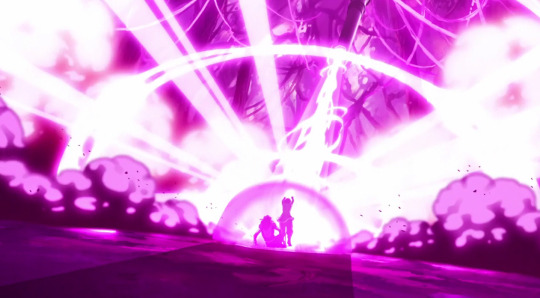
step in front of a spirit weapon of that magnitude and just trust that she could stop it.
“Attachment”
may not be the best English word to translate the concept from the
original language…..but still I like that both the shows bring up
these concepts. Its a good introduction. If you want more I recommend
the American Buddhist Writer Brad Warner translating Dogen Buddhism
for the Modern Western audience.
Goal: Write 1 thought every day re: why I love ATLA (until I finish rewatching the series)
#41: Aang energybends Ozai in “Sozin’s Comet Part 4: Avatar Aang.”
The ending of ATLA is controversial (apparently). Deus Ex Lion Turtle. I personally loved it (and still love it), and have even fewer problems with the energybending than with the Rock.
True, the lion turtle itself could have been set up much better – for example, the show could have slipped a few extra lines when the lion turtle appeared in the book in “The Library” and revealed that lion turtles used to give people the elements. The show could have dropped a few more references to how lion turtles used to protect humans in other episodes here and there. So yes, the mechanism could have had better set up.
But the theme has been consistent and present throughout the show. The show explored the theme of Aang being afraid and out of control in the avatar state as early “The Avatar Returns”: the very first time we see him enter the avatar state, Aang emerges confused and not quite knowing what happened.
And “The Avatar State” directly confronts this idea, including with this line from Katara:
Katara: I’m not saying the Avatar state doesn’t have incredible—and helpful power. But you have to understand, for the people who love you, watching you be in that much rage and pain is really scary.
Aang is always in pain, or rage, when he enters the avatar state. See, e.g., “The Southern Air Temple”; “The Desert.” And it’s something that he must be brought out of to return to himself.
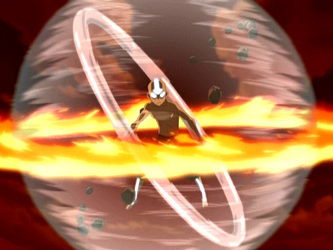
The animation in the final Aang v. Ozai sequence confirms this idea that the avatar state is frightening: Aang in the avatar state is alien, beastly, otherworldly, a vessel for the avatar spirit and the spirits of those that came before him. Just look at how un-Aang these images are:
So when Aang gains control of the avatar state, it’s a relief. This is the kid we’ve gotten to know over three seasons of television: the one that values human life, the one that redirects lightning elsewhere in the middle of a battle:
This is the kid who learned seismic sense from the greatest earthbender of all time:
Okay, so he gained a new crazy spirity skill from a giant lion turtle. It’s a bit out of left field:
But the result is fitting, and beautiful:
Thematically, it ties in with ideas that have been seeded and explored throughout the whole show. So although the mechanism seemed to come out of nowhere, the ending felt … right. It felt like the right one for this show, and the right one for Aang’s character.
Haters gonna hate, but I love the ending.
I wanted to tack on another thought to why I found Aang’s energybending to be so thematically fitting. Aang choosing to forge his own path — in the face of seemingly countervailing advice from everyone (including his own past lives) to kill the Fire Lord — fits in perfectly with the theme of actively shaping your own destiny.
The show has seeded that idea throughout, including in “The Fortuneteller,” where Aunt Wu tells Aang, “Just as you reshaped those clouds, you have the power to shape your own destiny.” Avatar Kuruk’s advice echoes this.
We also see that same idea reflected in Zuko’s story arc, as he has to choose his own way at the crossroads of destiny, and forge his own path after making the wrong choice. So putting Aang in that same position once again draws the parallels between the two protagonists.
person: *once again wonders how Legolas couldn’t figure out the password to the Doors of Durin*
me: why would Legolas, someone who grew up in a time when elves lived mostly isolated, didn’t get along with dwarves at all and unknowingly lived around two thousand years next door to Sauron, ever consider that there could be enough trust between the races to just put the password right onto the god damn door itself?
Also, why Legolas?
Aragorn probably speaks better Quenya and more dialects of Sindarin, grew up in the sanctuary to which the last refugees of Eregion fled, knows Galadriel (who has definitely been through before and used to live in Eregion) and he has been through Moria before himself.
Gimli is descended from the kings of Khazad Dum.
Gandalf actually says he used to know every possible password, but has forgotten most of them (I feel this).
Frodo speaks Quenya and at least one dialect of Sindarin, and was taught by Bilbo, who knows Gildor Inglorion, who is someone who may well have visited Eregion in its heyday, and comes from a culture known for riddle-games.
Even Boromir might know something from the old lore of Gondor.
Whereas Legolas has never been to Moria or Lorien, possibly doesn’t speak Quenya or any dialect of Sindarin apart from his own, and knows nothing about Dwarves! He’s the least likely person to know, apart from Merry, Pippin, Sam and maybe Bill the Pony. (I say maybe, because Bill the Pony may have hidden depths, given that he seems to have worked for someone who knew the Nazgul and was able to outrun wolves and get back to Rivendell.)
And! When Sauron rose before, and destroyed Celebrimbor’s beautiful city where the different Free Peoples worked together in friendship, and murdered Celebrimbor and took the rings, and the doors of Khazad-dum were shut …
It would have fulfilled every distrust that the Wood Elves ever had, all the traumatized commitment to private, guarded forests that the Sindar brought away from Beleriand, all the determination to depend on none but themselves that the Silvans had always maintained.
All their sourness about the last Noldorin exiles like Celebrimbor and Galadriel.
“See what a ruin Eregion came to the end!” they said. Though they wept, too.
And Gil-Galad and Elendil might have made things better, showing how such a friendship among different kinds might work, if they lived, but they didn’t.
Gil-galad had no heir.
And Isildur never made it back to Rivendell, as he purposed, to get Elrond’s help with the Ring (and apologize for the way he was on the day on Mount Doom, which hurt his heart to think of).
After the Dagorlad slaughter, Thranduil searched the marshes for his father Oropher’s body, I think, but he never found it.
And so he rode home again to his woods in the North. And there he stayed.
He made his peace with Elrond, because who could keep themselves from being friends with Elrond, if he was set on it? But Thranduil never spoke to Galadriel again, till they met after the destruction of Dol Guldur at the end of the War of the Ring.
Legolas grew up hearing of the world outside the Woodland Realm: but not good things.
(I imagine Galadriel and Celeborn were shocked when Thranduil’s child showed up with the Fellowship, looking like a softer copy of his father–if it were possible to be shocked amid all the other disasters and perils. And when Gimli of Durin’s line began trading gallantries with Galadriel, Legolas glanced at him with wonder … )
I love this discussion! But I do think it was in Quenya. In LOTR, in the chapter Journey in the Dark, Gandalf speaks of the writing on the doors–he says “The words are in the eleven-tongue of the West of Middle-Earth in the Elder days.”
Frodo says just before this that he “thought I knew Elf-letters but I cannot read these.” He was familiar with Sindarin, from Bilbo.
I actually wrote a fic about this moment about a year ago.
It’s definitely Sindarin, both the language and the script.
Frodo’s problem is that it’s written in the Beleriandic mode, which is inherently different from both the Quenya and the “modern” Sindarin usage of Tengwar. In the Mode of Beleriand, (most) vowels are not written as diacritics either on top of the preceding (Quenya) or subsequent (Sindarin) consonant, but rather as individual signs.
What Frodo and Legolas would have been able to read:
What the Doors of Dúrin said instead:
As you can see, these look quite different. To Frodo, the latter would read “pidy willyr 0 w[stem without vowel]ny” if he approaches it as Sindarin, or “p[-i]ndȝ v[-i]llȝr 0 v[stem without vowel]nȝ” if he approaches it as Quenya, neither of which makes any sense.
Hence Frodo’s confusion. Hence also Gandalf’s “tongue of the West of Middle-earth in the elder days” (note that it’s the west of ME, not the West in the sense of Valinor). The Mode of Beleriand survived the sinking of same and was used throughout Beleriand in the Second Age, but after that, it fell out of use and was replaced with the “general” mode, which is what Frodo and Leggy are familiar with.
In Quenya, “Speak friend and enter” (either with or without commas ;)) would be roughly “á quetë




 radiantanor.home.blog