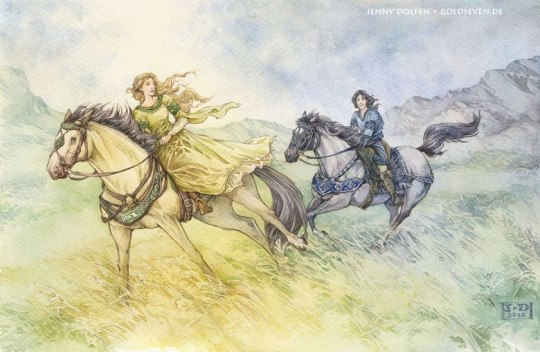
Éowyn and Faramir. Watercolour on Legion Stonehenge cold pressed paper, 21×31 cm.
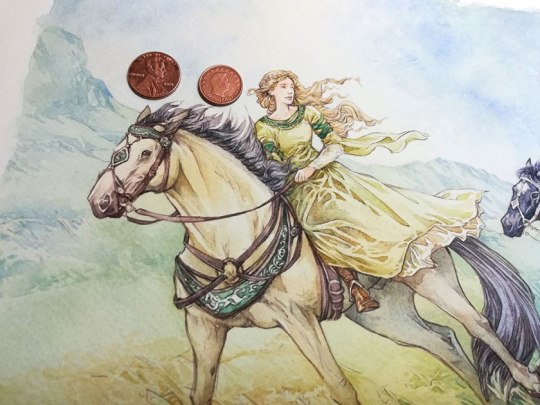
By coincidence, I found that I owned an American cent, and realised that it was way larger than the Euro cents I’m used to – here they are side by side.
Doing any sort of small detail is still incredibly hard for me, and I pay for it with headaches and having to paint in little half-hour instalments over several…
This was so obvious when I realized it, but I think most people miss
it, because we’re so desensitized by D&D-style magic with immediate,
visibly, flashy effects, rather than more subtle and invisible forces
of magic. When Gollum attacks Frodo on the slopes of Mount Doom, Frodo
has the chance to kill him, but he doesn’t. Instead, he says:
Frodo: Go! And if you ever lay hands on me again, you yourself shall be cast into the Fire!
Frodo’s not just talking shit here. He is literally, magically laying a curse. He’s holding the One Ring in his hands as he says it;
even Sam, with no magic powers of his own, can sense that some powerful
mojo is being laid down. Frodo put a curse on Gollum: if you try to
take the Ring again, you’ll be cast into the Fire.
Five pages later, Gollum tries to take the Ring again. And that’s exactly what happens.
Frodo’s geas takes effect and Gollum eats lava.
On further reflection:
All the other people in the franchise who were offered the Ring declined to take it because they were wise enough to know that if they used its power – and the pressure to do so would be too great – they would be subject to its corruption.
Frodo uses the power of the Ring to lay a geas, and then five minutes later at the volcano’s edge, succumbs to its corruption. The Ring has gotten to him and he can no longer give it up. Because he used its power.
On further further reflection: I’d have to read the section again, but I recall that after throwing Gollum off and laying the geas, Sam observes that Frodo seems suddenly filled with energy again when previously he had been close to dead of fatigue. He hikes up the mountain so fast he leaves Sam behind – and doesn’t even seem to notice that he’s left him behind.
Could he have been drawing on the Ring’s power at this point in the story?
At this point in the story we’re relying on Sam’s narration, and Sam doesn’t know what’s going on in Frodo’s head, so it’s hard to say for sure.
Having used it once, after spending so long holding out against it, was that the breach in the dam?
Which means that the moment that Frodo succumbs to temptation is not the moment at the volcano – it was already too late by then. The moment he is taken by temptation was when he used the power of the Ring to repel Gollum.
If so, this ties in neatly with discussions I’ve seen about how Tolkien subscribes to a “not even once” view of good and evil – that in many other works it’s acceptable to do a small evil in service of a greater good, but in Lord of the Rings that always fails.
Re-reading Fellowship of the Rings, and I got to this passage in Lorien:
‘I would ask one thing before we go,’ said Frodo, ‘a thing which I often meant to ask Gandalf in Rivendell. I am permitted to wear the One Ring: why cannot I see all the others and know the thoughts of those that wear them?’
‘You have not tried,’ [Galadriel] said. ‘Only thrice have you set the Ring upon your finger since you knew what you possessed. Do not try! It would destroy you. Did not Gandalf tell you that the rings give power according to the measure of each possessor? Before you could use that power you would need to become stronger, and to train your will to the domination of others.’
In other words:
Frodo asks Galadriel, herself carrying a Ring of Power, “Could I, hypothetically, use the power of the One Ring to do something magical aside from turning invisible?” and Galadriel replies, “Yes, hypothetically, you totally could, assuming the magic you want to do involves laying compulsions on others, but I strongly recommend against it, because it would fuck up your brain.”
This was in the first book. At the end of the third book Frodo uses the Ring to fuck Gollum up, forcing him to throw himself into lava if he disobeys Frodo’s commands.
Talk about a chekov’s gun.
Got to this point in my re-read and uh. This was a lot less subtle than I remembered it.
‘Down, down!’ [Frodo] gasped, clutching his hand to his breast, so that beneath the cover of his leather shirt he clasped the Ring. ‘Down, you creeping thing, and out of my path! Your time is at an end. You cannot slay me or betray me now.’
Then suddenly, Sam saw these two rivals with other vision. A crouching shape, scarcely more than the shadow of a living thing, a creature now wholly ruined and defeated, yet filled with a hideous lust and rage; and before it stood stern, untouchable now by pity, a figure robed in white, but at its breast it held a wheel of fire. Out of the fire there spoke a commanding voice.
‘Begone, and trouble me no more! If you touch me ever again, you shall be cast yourself into the Fire of Doom.’
Then the vision passed and Sam saw Frodo standing, hand on breast, his breath coming in great gasps, and Gollum at his feet, resting on his knees with his wide-splayed hands upon the ground.
Most composers spend just 10-12ish weeks working on a film’s music. John Williams spent around 14 weeks on each Star Wars movie, 40ish weeks total for the whole OT……but composing the LOTR trilogy’s soundtrack took four years
The vocals you hear in the soundtrack are usually in one of Tolkien’s languages (esp. Elvish). The English translations of the lyrics are all poems, or quotes from the book, or occasionally even quotes from other parts of the films that are relevant to the scene
When there were no finished scenes for him to score, Howard Shore would develop musical themes inspired by the scripts or passages from the book. That’s how he got all Middle-Earth locations have their own unique sound: he was able to compose drafts of “what Gondor would sound like” and “what Lorien would sound like” long before any scenes in those places were filmed
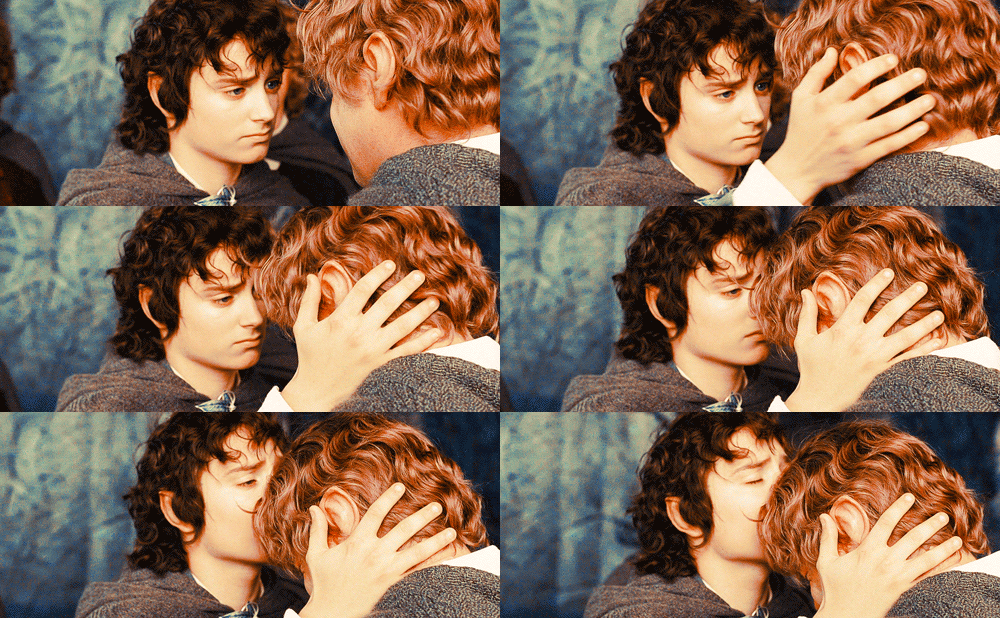
Shore has said his favorite parts to score were always the little heartfelt moments between Frodo and Sam
Shore wrote over 100 unique leitmotifs/musical themes to represent specific people, places, and things in Middle Earth (over 160 if you count The Hobbit)
The ones we all talk about are the Fellowship theme, the main Shire Theme, and the themes for places like Gondor, Mordor, Rohan, and Rivendell…but a lot of the more subtle ones get overlooked and underappreciated
Like Aragorn’s theme. It’s a lot less “obvious” than the others because, like Aragorn himself, it adapts to take on the color of whatever place Aragorn is in: it’s played on dramatic broody stringed instruments in Bree, on horns in battle scenes, softly on the flute with Arwen in Rivendell….
Eowyn has not just one but three different leitmotifs to represent her
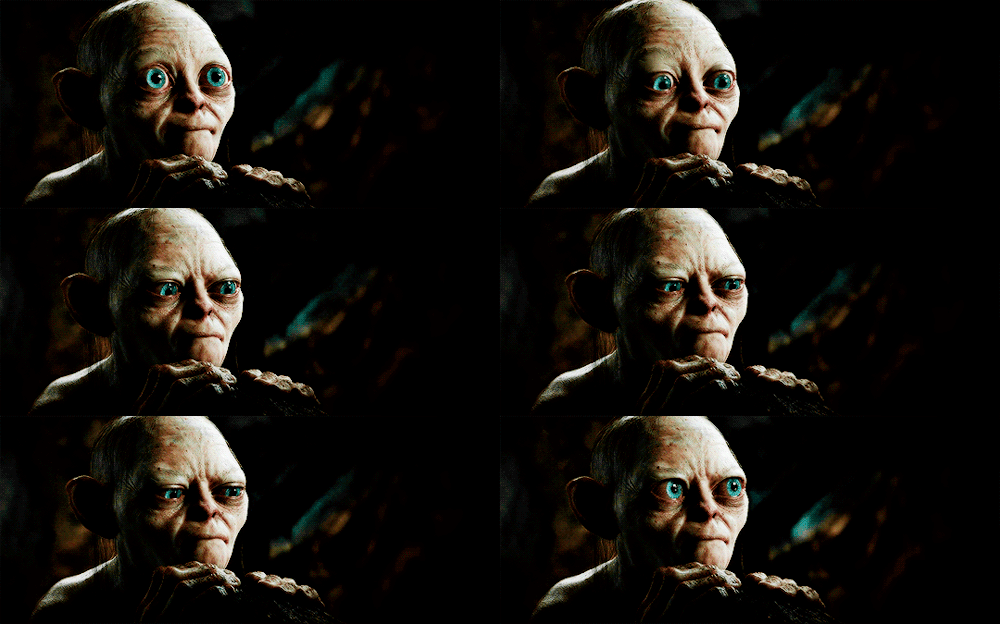
Gollum and Smeagol both have their own leitmotifs! Whose theme music is playing in the scene can often tell you whether the Gollum or Smeagol side is “winning” at the moment
The melody for Gollum’s Song in the end credits of the The Two Towers is the Smeagol and Gollum themes smushed together (it’s Symbolic)
And then there’s the really obscure ones. Like there’s a melody that plays at Boromir’s death that shows up again in ROTK in scenes that foreshadow a major death or loss
Shore wanted the theme music to grow alongside the characters– so that as the characters changed, their theme music would change with them.
You can hear that most clearly in the Shire theme. Like the hobbits, it goes through A Lot
Like compare the childish lil penny whistle theme you hear in Concerning Hobbits/the beginning of FOTR with (throws a dart at random Beautiful Tragic Hobbit Character Development scene because there WAY TOO MANY to choose from) the scene when Pippin finds Merry on the battlefield, where you hear a kind of shattered and broken but more mature version of that same theme in the background
I could write you a book on how much I love the way the Shire theme grows across the course of these films
Unlike the hero’s themes, which constantly change and grow, the villain’s themes (The One Ring theme, the Isengard theme, etc) remain basically the same from the very beginning of FOTR to the end of ROTK. Shore said this was an intentional choice: to emphasize that evil is static, while good is capable of change
Shore has said that between all the music that made into the movies and the music that didn’t, he composed enough for “a month of continuous listening”……..where can I sign up
So there’s that scene in The Two Towers where everyone’s holed up in Helm’s Deep and are super outnumbers and probably gonna die.
To bolster their forces, they decide to arm the old men (ok, fair enough) and … the young boys? Meanwhile all the women cower in the caves.
What.
Like excuse me, in what way is a nine year old peasant boy with no training, who can barely see over the battlements, and who can probably barely lift a sword … in what way is that small child a more suitable combatant than an angry peasant woman who’s been slinging haybales and taming horses and rolling big barrels of mead and lifting pigs under her arms for all thirty years of her life. At the very least she can see over the battlements and lift a weapon. Depending on her place in society she almost certainly knows how to hold a rake or a scythe or a hammer or lift logs. She knows how to butcher animals, and has likely done so many times with giant knives and gotten covered in gore and viscera. Give her a cleaver on a stick and say “have at it, ma’am.”
Nobody in Helm’s Deep should be giving a flying fuck about “gender roles” when there’s an army about to come in and slaughter them to the last child. They should be thinking strategically. And strategically, arming untrained children is a bad idea, and arming strong adults with a basic grasp of how to wield a big weapon is a good idea.
Just in case you thought I was kidding – here’s the heraldry for the Mordor Special Mission Flying Corps, drawn by Tolkien himself.
“It apparently was a badge that applied to Sauron’s air-borne troops, probably including the later incarnations of the Nazgûl and, perhaps, any remaining dragons under Sauron’s command. The “wings” at the side of the emblem are given a feather-like texture, which might indicate that they were originally real wings. A mystifying scribble, saying “Seen from below”, actually hints that the emblem portrays one of Sauron’s flying creatures, and the small “horns” indicated between the wings and the body of the creature could then be the feet of someone riding the beast. But it is clear that if so, the portrait must be extremely stylized. On the wings can be seen the image of Sauron’s eye, multiplied like the eyes on peacock’s wings.” [x]
This is so undeniably cool. All I can imagine now is this Nazgul Flying Corps in WW2 outfit.





 radiantanor.home.blog