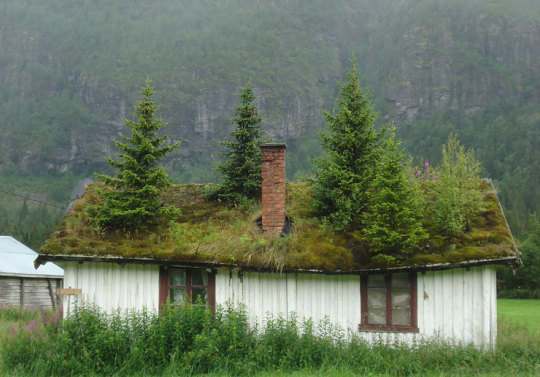
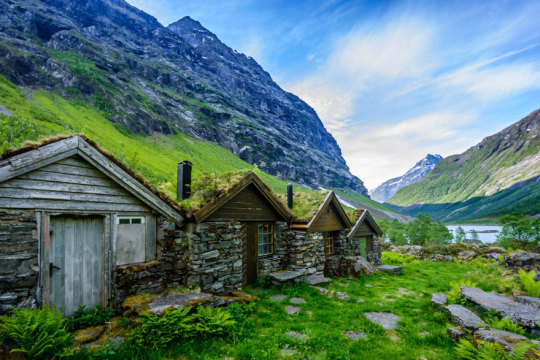
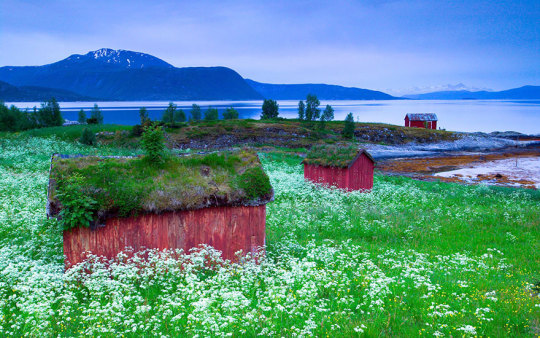
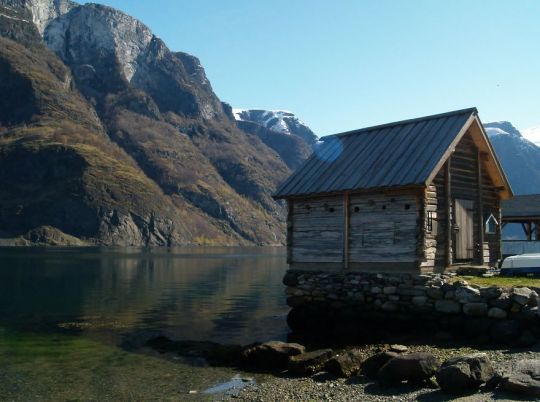
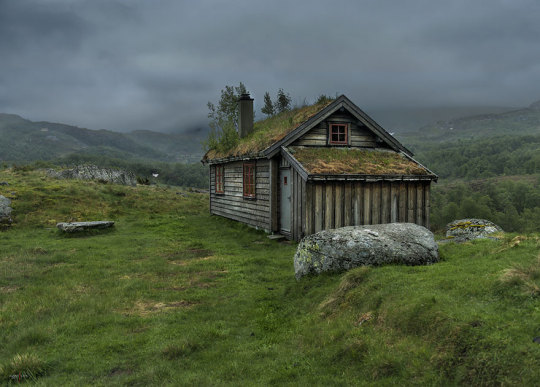
The Norwegian countryside is strewn with architecture that looks better suited to crown the pages of a fairytale book. More commonly known for its Vikings heritage and fjords, these photographs display a wide variety of architectural styles that have been used throughout the Middle Ages to the 19th century in Norway. Check out the stunning collection below.
Crooked and towering wooden churches beckoning like an old crone’s fingers, winding stone path weaving through a forest, hidden waterfalls and lonely wooden cabins overlooking a vast valley at its base are some of the outlandish homes and architectural designs we have featured in this series. Teetering Stave churches, eerie waterfalls cascading down like a creature with its own mind, wooden homes made in the typical Norwegian indigenous style called byggeskikk have none of the linearity or conformity that modern buildings do, and have whimsical elements that heighten its sense of magic.
Each of these structures below have a particular way of being set into its own environment, standing out from the elements without obstructing nature. Most of the buildings and bridges and pathways have been built with stone and wood balance the scene it has been engineered upon.
Mermaids are popular lately. I guess that makes now as good a time as any to talk about Hans Christian Andersen’s The Little Mermaid.
Which desperately needs to be talked about. Seriously, the situation is dire.
Everyone knows the Disney version, which I happen to like very much, but it’s a different story, about different things. Starting with the Disney version, we’re all sort of trained to see Prince Charming as the only possible happy ending.
Most people also know that in Andersen’s version, the mermaid dies in the end. And this is where things get difficult. First, there are a lot of picture books that end with her dying, and they have Andersen’s name on the front, and naturally everyone assumes they’re telling the original story. If you read a twenty page picture book that was just the Disney story condensed, until suddenly it ended with death, you did not read the original.
Also, there’s this idea going around that she committed suicide because the prince didn’t love her. That is not what happened at all, and I don’t know how the rumor got started, but it really bugs me.
So I’ve got a collection of Andersen’s fairy tales in front of me right now, and I’m actually really frustrated because the title page doesn’t name a translator, but it’s got 47 of his stories in it, and my dad bought it in Germany. The Little Mermaid is 35 pages without illustrations, I have done my research, and I’m completely sure it’s the real, full story.
The mermaid’s got a bunch of sisters. They’re all kind of interested in our world, because they’re not allowed to go to the surface until they reach a certain age. But the novelty wears off for the others. Our mermaid, much like Ariel, is a little obsessed. Already, this is about more than a cute boy. The mortal world is something that fascinated her long before she met the cute boy.
And then she saves his life. And she’s got a crush on him. It’s bad. She spies on him a lot. Her sisters help her find his house. But she doesn’t actually do anything. Days pass. Maybe weeks. Probably weeks. And then she talks to her grandma, and finds out that although they have much shorter lifespans, humans have immortal souls.
This is important. The Little Mermaid is part of a large group of folk and fairy tales with this same basic idea. Humanoid creatures that are not human have human rationality, but lack immortal souls. It’s terrible, because they have the ability to understand exactly what they’re missing. So these creatures—fairies, elves, trolls, assorted sea beings—have one shot at a soul. Some stories say you only have to marry a human, others say you have to bear his children (sucks to be a merman, I guess).
She’s been obsessed with humanity forever, and she’s totally in love with this guy. But it’s not until she learns about the soul that she does anything. This is about the boy, yeah, but it’s also about the soul, and in the long run the soul is more important.
So she goes to the sea witch—who, by the way, warns her that this is stupid. And the deal is that she can become a human (which will be intensely painful), in exchange for her tongue (she cuts it out), and if he marries her, she gets the soul. If he marries no one, presumably she lives a normal human life, and dies in thirty or forty years with no soul. (The text really isn’t clear here.) But if he marries someone else, then she dies and turns into sea foam (which sounds weird but apparently it’s what all mermaids do when they die). Really, it’s a pretty generous deadline for a witch.
The prince finds her naked on the beach and takes her home, like a stray dog or something. A lot like a stray dog. Seriously. Let’s look at this relationship.
Everyone was enchanted by her, especially the prince, who called her his little foundling…The prince said she was to stay with him forever, and she was allowed to sleep outside his door on a velvet cushion.
A velvet cushion. Wow. Talk about your healthy romantic relationships. Not a bedroom. Not a bed. She is allowed to sleep on a cushion in the hallway.
What a privilege. I am so jealous.
Next, he has some boys’ clothes made for her so they can ride horses together.
Is she his pet? Is she is little brother? I have no idea. When I told my mom the story, she said, “So basically what he wants is a pet friend.” I think that sums up the situation pretty nicely.
But wait, there’s more.
Day by day the prince grew fonder of her. He loved her the way one loves a dear, good child, but to make her his wife did not occur to him at all.
’Of course I love you best,’ said the prince, ‘for…You are devoted to me, and you resemble a young girl I once saw but will certainly never find again…She was the only one I could love in this world. But you look like her…and so good fortune has sent you to me. We shall never be parted!’
Then his parents want him to go meet a princess. He tells the mermaid:
‘I cannot love her. She doesn’t look like the beautiful girl in the temple, whom you resemble. If I should ever choose a bride, you would be the more likely one, my mute little foundling with the sparkling eyes!’
And this is where it gets really interesting:
And he kissed her rosy mouth, played with her long hair, and rested his head upon her heart, which dreamed of mortal happiness and an immortal soul.
Which she’s never gonna get. Why? Because this guy’s a loser.
You give a girl a nice little doggy bed. You treat her like a boy. You talk to her like a child. You tell her you love someone else. And what do you do next? You kiss her.
This is not Prince Eric. This is not Disney. Reading this story, I don’t want her to end up with this prince. That’s not a happy ending at all. He doesn’t even treat her like a person, and she deserves so much better.
So the prince goes and meets this princess. And the princess ends up being the girl that he loves from the temple. (He thinks she saved his life. Actually it was the mermaid. I’m really curious about what would have happened if he’d learned the truth.)
He’s going to marry her immediately. The deal with the witch says our mermaid dies the first morning after the wedding. She holds the bride’s train. She participates in the wedding that’s going to kill her, because she’s a sweet person who really loves this guy who treats her like a pet, and it is devastating.
Her sisters are also really sweet. They made a deal with the sea witch, too. In exchange for all of their hair, they get a knife, and they tell our mermaid:
Before the sun rises, you must plunge it into the prince’s heart! And when his warm blood spatters your feet, they will grow together into a fishtail, and you will become a mermaid again and can sink down into the water to us, and live your three hundred years before you turn into the lifeless, salty sea foam.
His life for a do over. I’d totally take that deal.
Maybe not. But I have a long list of fictional people I would like to slap, stab, or strangle, and he is definitely on it.
Anyway, the little mermaid is a much better person than me, and she’s not gonna kill this guy. She jumps into the sea. I think this is where people get the suicide idea, but the sun is just coming up now. She’s about to turn into sea foam, and being a very considerate sort of person, she’s going to do it in the water, so no one has to clean her up. She is literally seconds away from a natural death. She’s not killing herself. Knowing that she’s going to die regardless, she is choosing a place to die in.
And it’s quote time.
Once more she gazed at the prince with dimming eyes, then plunged from the ship down into the sea. And she felt her body dissolving into foam.
Now the sun rose out of the sea. The mild, warm rays fell on the deathly cold sea foam, and the little mermaid did not feel death…she saw the clear sun, and up above her floated hundreds of lovely transparent creatures…The little mermaid saw that she had a body like theirs. It rose higher and higher out of the foam.
So she becomes a Daughter of the Air. Daughters of the Air create their own souls with good deeds. It takes about three hundred years. So basically she gets to hang around for the length of her normal mermaid lifespan, and then she’ll have a soul and she can go to Heaven. Also she gets to talk again. This is not actually a tragic ending. She wins. She gets the soul. She doesn’t get the prince, but I have a feeling the Daughters of the Air are gonna treat her a lot better than he did, so who cares? She’s going to Heaven.
Now at the very end Andersen mentions that if the Daughters fly past a naughty child, they’ll get another year added to their 300, but mostly this seems to be a scare tactic for young readers, so let’s just focus on the happy part where the little mermaid does technically die, but also gets eternal life.
Also, if you want to read more of this type of story, where marriage=soul, you should totally check out Undine, by Friedrich de la Motte Fouqué. It was written before The Little Mermaid, it also involves a sea person, it’s much more painful, it’s a little more explicitly religious, and it is absolutely beautiful. Also it’s free online, and George MacDonald Approved:
Were I asked, what is a fairytale? I should reply, Read Undine: that is a fairytale … of all fairytales I know, I think Undine the most beautiful.
I didn’t realize how badly the Prince treated her when I read it as a child, but I do remember thinking that he should get his shit together (I didn’t put it like that of course) and stop being an idiot. He didn’t even seem to realize that she loved him, and seeing as she probably didn’t hide her feelings it means he just didn’t take her feelings seriously. I mean, even though it’s a fairy tale I can’t quite blame a prince for marrying politically (or even for falling in love with someone else), considering that he didn’t know it would kill her. But
at the very least he should have been more tactful and considerate to her. He didn’t even notice that there was a problem, never mind try to find out what it was.
I’m really glad the Little Mermaid got a chance to gain a soul. As a child, I used to consider the ending a bittersweet one because I thought she should have gotten more time to live in the world without pain (though that had frustrated me less than the fact that she was bound to the Prince and couldn’t just pick some other human guy). But it was perhaps the first story I read where the main character dies, and while that is tragic the “afterlife” is described as the beginning of another, more hopeful journey – the chance to complete what she had set out to do. It’s one of the stories that positively infuenced the way I thought of death. I’d read it so long ago that it ended up somewhere at the back of my mind, and this post got me to remember.
Gaston really is the most terrifying Disney villain because he could be anyone in the world.
Later he convinces the whole town to set up his wedding with the knowledge that the would-be bride would be thrown into it. Everyone finds his creepy-ass tactics as cute and “boys will be boys” esque. So yeah, he is terrifying.
Yeah, the truly scary thing about Beauty and the Beast isn’t that Gaston exists, but that society fucking loves him. People who deride the movie by saying it’s about Stockholm Syndrome are ignoring that it’s actually about the various ways that truly decent people get othered by society. People don’t trust the Beast because of the way he looks, which only feeds his anger issues and pushes him further away. Gaston isn’t the only one who criticizes Belle for being bookish, either; the whole town says there must be something wrong with her. And her father gets carted off to a mental asylum for being just a little eccentric.
Howard Ashman, who collaborated on the film’s score and had a huge influence on the movie’s story and themes, was a gay man who died of AIDS shortly after work on the film was completed. If you watch the film with that in mind, the message of it becomes clear. Gaston demonstrates that bullies are rewarded and beloved by society as long as they possess a certain set of characteristics, while nice people who don’t are ostracized. The love story between Belle and the Beast is about them finding solace in each other after society rejects them both.
Notice how the Beast reacts when the whole town comes for him. He’s not angry, he’s sad. He’s tired. And he almost gives up because he has nothing to live for. But then he sees that Belle has come back for him, and suddenly he does. In the original fairy tale, the Beast asks Belle to marry him every night, and the spell is broken when she accepts. In the Disney movie, he waits for her to love him, because he cannot love himself. That’s how badly being ostracized from society and told that you’re a monster all your life can fuck with your head and make you stop seeing yourself as human.
Society rewards the bullies because we’ve been brought up to believe that their victims don’t belong. That if someone doesn’t fit in, then they have to be put in their place, or destroyed. And this movie demonstrates that this line of thinking is wrong. It’s so much deeper than a standard “be yourself” message, and that’s why it’s one of my favorite Disney movies.
Yeah okay, that might have been the intended message of the movie, but the Beast is literally an abuser, he literally abuses and imprisons Belle, she tries to escape (as many abuse victims do) and ends up back with him because it’s just too scary out there without her abuser whose violence protects her.
It’s literally textbook abuse, textbook stockholm syndrome, and it’s great if you can find positive messages in that movie but please don’t hand-wave the abuse that Belle endures or the fact that her happy ending is literally her reward for loving her abuser and choosing to stay – and her reward is no longer being terrified and imprisoned.
Please don’t ignore the damaging messages in that film just because you want to talk about one of the better ones – how many young children have seen, will see Belle terrified of a controlling person with an explosive temper and zero self-control, and then see that if you just love someone like that enough they’ll turn into a kind and gentle prince?
This story might have been great if the Beast hadn’t been written as abusive. Or if he had been and Belle had succeeded in leaving. Or if her staying with him was read as tragic. But as it stands, we’re supposed to think it’s romantic that this young woman fell in love with a cruel and terrifying person who imprisoned and controlled her.
We hear too many stories like that already and if you justify the Beast’s abuse of Belle because others have rejected him, or because it’s somehow her job to love her abuser because he can’t love himself, guess what, you’re supporting one of the more popular narratives that real-life abusers use to control their victims.
No.
I’m sorry but you’re wrong.
Belle did not fall in love with her abuser.
I will not deny that Beast was abusive in the beginning. He was downright beastly. And Belle hated him. And feared him. And was disgusted by him.
And it’s only then that Belle starts to care about him.
Leading to them slowly developing a friendship and eventually “something more”.
Leading to one of the most beautiful Disney moments:
But even then, when her father is shown in the woods, Beast tells her to go and Belle goes!
She only comes back, not because “it’s just too scary out there without her abuser whose violence protects her” (that’s just ludicrous!) but because she genuinely cares about the man that the Beast became. (And she despised the monster that Gaston had become.)
The point of the story is that, over a period of time, the ‘monster’ became humanized and the ‘human’ became a monster.
YES. MOTHER. FUCKING. THIS.
I have gotten so sick and tired of people diminishing Belle’s personal power and the importance of her story by saying she only stayed with the Beast because of “Stockholm syndrome.”
This movie starts with Gaston and the Beast having basically the same entitled attitude towards the world: they feel they’re OWED whatever they want because they’re somehow superior. Belle is the catalyst and the lynchpin, and the difference in the characters of the two men becomes blatantly obvious in how they react to not getting what they want from Belle.
Gaston sulks and pouts and tries to force her to marry him, to the point that he convinces the entire village to help him plan a shotgun wedding with an unwilling bride, institutionalize her father, and even storm a castle to murder an unknown “monster,” still with the idea that with no Beast, Belle will be “his.” The most telling thing is that despite how much Gaston claims to want Belle, the moment she publicly rejects him (”He’s no monster, Gaston! YOU are!”), he immediately dismisses her as crazy and locks her in a cellar while he goes off to kill the person she actually cares about.
Beast sulks and pouts…and then makes significant changes to his behavior and his manners, both to show Belle that he cares for her and that he CAN be a better man. He changes both FOR Belle and BECAUSE of her. He pays attention to what she says, what she doesn’t like, and what makes her happy. And she’s not afraid to tell him, in no uncertain terms, exactly what he’s doing wrong.
“If you’d hold still, it wouldn’t hurt as much!” “Well, if you hadn’t run away, this wouldn’t have happened!” “If you hadn’t FRIGHTENED ME, I wouldn’t have run away!” “…..Well, YOU shouldn’t have been in the west wing!” “Well, you should learn to control your temper!”
This is not the behavior of a woman too afraid of the Beast to leave and too cowed by abuse to stand up for herself. The Beast literally shouts in her face, and she barely flinches. This is a woman in full control of her life and completely able to make her own choices. If the Beast hadn’t changed, if he’d acted like Gaston instead of demonstrating radical self-improvement, if she thought for one second that her life was truly in danger, she would have left and never come back.
She’s spent the better part of her adult life standing up to and actively shutting down an overbearing and physically intimidating man who shows immediately and repeatedly that he has no respect for her wishes or her personal space. She is not going to back down just because someone growls and blusters at her, no matter how big his teeth are.
Belle is a force to be reckoned with.
And the message here is not, “If you love someone enough, you can fix them.”
The message here is, “If they actually love you, they won’t be abusive.”
I know this is long and all, but I want to at least emphasize that last part:
“If they actually love you, they won’t be abusive.”
Talking about a movie or not, that’s huge. It’s something I certainly wish I learned much sooner
Also, Belle doesn’t stay with the Beast after the wolf attack because
“it’s just too scary out there without her abuser whose violence protects her,” she stays because he got hurt saving her life and while the only reason her life was even in danger to begin with was because he flipped his shit (a fact which she is not afraid to confront him with), she’s willing to allow him enough grace to help him in turn instead of leaving him freezing and bleeding in the middle of the woods. Because Belle is not just brave and smart, she’s also noble–noble enough to take her father’s place in captivity because she’s younger and healthier and can survive it, and noble enough to walk back into the lion’s den to help someone who needs her, even if he’s done little to deserve it up until that point.
Belle is nobody’s victim. She is the hero of her own damn story and deserves your respect.
!!!!!!!!!!!!!!!!!!!!!!!!!!!!!!!!!!!!!!!!!!!
I love you all so much.
The Beast was an entitled brat when he was younger, it’s true – turning away the ‘old woman’ when it would have been no imposition whatsoever to let her stay was a cruel and selfish thing to do. And he was incredibly bitter – understandably so – at his punishment and isolation. It’s worth noting that his servants suffered a similar punishment and isolation while having done nothing to deserve it and were not nearly as bitter – though their apparent inability to stand up to him didn’t help his development. He then imprisoned another old person who sought shelter with him when, again, it was no skin off his nose to let Maurice recuperate for the night. The Beast could easily have been the villain of the film, no doubt about that, and many viewers would have defended him and blamed it on his past traumas in a way that makes the townsfolk’s adulation of Gaston despite his clear assholery feel very familiar.
But he didn’t – the moment he realized he had someone who made him want to actually behave better for her, he did so. The Beast is important precisely because he wasn’t ‘a truly decent person othered by society’ until he became one. Because he saw Belle, realized she was a nice person and thought to himself “I want to be like that. I want to make her happy, even if it means I lose my one chance at regaining my normal life”. Gaston, on the other hand, saw Belle and thought to himself “I want her, because I deserve the best”. As was said above, the issue is not that you can love your abuser into changing, it’s that if that person actually loves you, they will make a real effort to change for your sake – and they won’t give up at the first backslide either. There are addicts who turn their lives around when they realize it will cost them the person or people that matter more to them than the thing they’re addicted to. Just because love doesn’t always redeem, doesn’t mean it never can. But it has to be the offender’s love for the person they wronged that redeems the offender, not the other way around.
“Gee guys IDK about Annatar his whole house seems really… unfriendly.” “OMG Danil you are so closed-minded, he’s ECCENTRIC.”
No really guys, this house just screams art deco and I am all over that.
This game is absolutely questionably canon but these details are astounding and a joy to look over.
“The Layout1. Entrance. Double doors faced with gold guard the from entrance to Annatar’s home.Actually made of eog, they are almost indestructible. When Annatar is out, they are kept locked, Sheer Folly (-50) to open. Only the Lord of Gifts has keys.
Well yeah, it’s his own house, he’s not going to just pass out his key to every person in Ost in Edhil. Though I guess when he is there anyone can just waltz on in, it is an RPG after all, no one has any privacy. Not even Dark Lords in their own home.
2. Rotunda. Forty-five feet high at the apex and forty in diameter, this room is devoid of furnishing and practically without decoration. The dome is covered with a silvery-while pearl finish; the walls are of pink marble. A black iron balcony runs the perimeter of the room, supported by ornate gold-leafed columns, All of the doors into this room are of mithril and can be locked. Extremely Hard (-30) to pick. At the apex of the dome is an oculus allowing light to enter, but covered with a sheet of clear laen. The floor of the room is a beautiful mosaic of highly polished marble and other stone, forming an arcane six-pointed compass. It is in fact an abstracted symbol relating to Morgoth. A 6’ diameter circle at the very center of the mosaic is a Sheer Folly (-50) to detect secret door, actually a lift. Only by standing in the center and thinking clearly the phrase— One Ring to Rule them all can the door be triggered. When the words are spoken,the section of floor lowers into the basement; a replacement floor section slides into place immediately, concealing Annatar’s departure
Sneaky sneaky. He’s dropping hints, but hey it’s art; entirely up to interpretation.
7. Library. Filled with innocuous volumes on poetry, fiction and history, as well as Noldorin science. Several fine works of an adorn the walls, and stand on marble pedestals, This room is actually furnished comfortably, with black leather upholstered chairs, and two reading desks of black dir-wood
Wait- what? What fiction? What sorts of fiction would Mairon read? I must know!
22. Dark Library. Behind locked Sheer Folly (-50) to pick iron doors is a library con-taining a collection of histories written from the Melkoric point of view, as well as spellbooks of all Essence and Channeling (including Evil) lists to 50th level
Who wrote these books and are they widely available? Is this a sanctuary for banned books?
Office. Annatar spends much of his time in this room, which is carpeted in pure white-wool. The wall facing the door and both side walls are of black marble, while the fourth is a single huge mirror. In the center rests a huge desk of polished ebon stone, with a carved dir-wood chair behind it. The other furnishings are of white enamelled wood
Man he loves that black marble. I do like the contrast of all the pale colors though so he’s really taken care to to over-power his home in dark colors. Gotta question to use of white carpet though.
Bedchamber. Dominated by a huge bed with headboard of carved oak
Nothing else?
Washroom. Annatar’s personal facility
Is the wash basin made of gold? Maybe more of that lovely black marble? ???
And there is more but these were the most interesting points in this game’s description of Annatar’s house.
Check out Lorien and the Halls of Elven Smiths for a bit of exploratory non-canon architecture and fascinating headcanons indulged in by nerds of the 1980s.
Thank you @edgeoflight for tracking down the manual and for an evening of fun for me looking over this. (for some reason it’s not letting me tag you)
Only by standing in the center and thinking clearly the phrase— One Ring to Rule them all can the door be triggered. When the words are spoken,the section of floor lowers into the basement; a replacement floor section slides into place immediately, concealing Annatar’s departure
That’s not a very strong password. Clearly, password-inventing skills are something he and Celebrimbor have in common.
I was wondering the same thing myself. He could have just carried them all in his new home, wrote them himself while he was there, or smuggled them inside when no one is looking. Either way that seems like a lot of effort on his part. Regardless, if he was not the sole author of those ‘Melkoric’ books I wonder who is and if they are widely known of?
Whatever he did, he’s still a giant nerd. I mean, he probably knows everything about the Melkoric pont of view by heart but he couldn’t just leave that rare first edition of a War of Wrath account lying around back home in Mordor. Who knows what some idiot servant might do to it while he’s gone. And he just found out that the Elves have totally skewed tales about the whole thing with Finrod, Beren, Luthien and Huan – he’d better write down his version of those events, so he can immediately shove it into their faces to correct them once he finally takes over.
I suppose the other authors may have been other Umaiar, or ‘Easterling’ scholars. (Like maybe a text by Ulfang, about their family’s desperate struggle to stop the House of Bor from being deceived by the Elves and joining them for real?) I’m sure there would have been some by the Black Númenorean priests too, but that was later. Sauron probably didn’t write that many himself but influenced a lot of the writers. I’m sure he’s the kind of person who likes giving interviews and talking about himself, making sure that he sounds ‘as great as he deserves’. (And now I have a mental image of Sauron being a bit like Gilderoy Lockhart. Yes, I do know he’s more competent than that.)
Pippin: finally i’m getting the respect i deserve from these peasants
so accurate i am choking on my carrot. this is making me giggle harder than it should. I love Pippin so much.
I don’t think there will come time when I’m not reblogging this. Sorry guys.
no no no you guys don’t understand, Pippin is someone really important in the Shire! The books don’t talk about it a lot, and the movies won’t touch that stuff with a bargepole, but Pippin will be inheriting land rights to about a quarter of the Shire. He’s second in line to becoming military leader of all Hobbits. His dad is currently in charge of that stuff, but he’s completely aware of it, and educated for it, and that’s why he’s such an over privileged little shit in the books.
I thought it was a shame the movies didn’t talk about class differences in the Shire. Also puts M&P stealing food in an uglier light.
To be fair, at the time of the Party, Pippin would have been 12, which puts it back into a more acceptable light. And they’re stealing food from Bilbo, a wealthy and eccentric family member, which again makes things a bit different.
But yes, when they call Pippin Ernil i Perrianath – Prince of the Halflings – they are actually completely spot on.
And when Pippin tells Bergil “my father farms the land around Tuckborough” he’s deliberately downplaying his class so that he can greet the boy as an equal rather than a superior. It’s Pippin’s most adult moment in the series. Bergil is engaging in a status contest which Pippin can totally win – but instead chooses not to compete. Pippin is a gilded and spoiled lordling in the Shire, but he becomes a Man of Gondor.
Yeah, to add a bit of unnecessary trivia/level of preciseness, Frodo is the oldest of the four; he was born in 2968, was (obviously) 33 at the time of the Party, and so he’s 51 here. Sam’s second-oldest; born in 2980, he was 21 when Bilbo left and is 39 at this point. Merry’s two years younger than Sam, making him 18 or 19 in 3001, when the Party took place, and Pippin was born in 2990, so he was actually 10 or 11 during the Party, and during this scene they’re ~37 and ~29, respectively.
So yeah, Pippin’s the youngest by a lot. Plus, taking hobbit aging into account, he really is still in the equivalent of his teens; remember the Party was half to celebrate Frodo’s coming-of-age at 33, and Pippin’s around twenty years younger than Frodo.
This fucked me up. I didn’t read the books and in the movie it was shown like Frodo took off with the ring like 2 days after Bilbo’s gone away, but it was 17 years after that. OMFG.
i’m not sure if it’s ever been explicitly stated but the movie and book follow different timelines
in the books, bilbo leaves the shire 60 years after his first adventure, giving frodo the ring. seventeen years pass before frodo sets out on his quest
in the movies, seventeen years cannot have passed while gandalf goes all nancy drew in denethor’s basement – for one, pippin is obviously not 10 in the party scene – but the story does allow us some wiggle room – maybe a few months, even a year or two? (I DUNNO DID JACKSON EVER SPECIFY GIMMIE NUMBERS)
this also accouts for a lot of the confusion re. aragorns age following thranduils advice to legolas at the end of BOFA – in the books, aragorn is about ten during the events of the hobbit, but in the contracted movie timeline, he tells eowyn he’s eighty seven, putting him somewhere around 27+ when legolas goes off to find him
also i think i heard some messing around was done with thorins age? i dunno BASICALLY THE MOVIE TIMELINE IS CONTRACTED AND FUDGED AROUND WITH AS MUCH AS THE MOVIE MAPS dont even get me started on those
BUT BACK TO PIPPIN
so pippin does indeed become the thain, merry also become the head of his ginormous family – the master of buckland, in fact
but you know whats best of all
SAM BECOMES MAYOR OF THE SHIRE
SAMWISE GAMGEE BECOMES ELECTED MAYOR OF THE SHIRE SEVEN TIMES
k so to understand the importance of this you gotta remember that sam is poor
he comes from a poor family – so poor, in fact, that i’m fairly certain that sam was the only one of them who could read – and only because bilbo taught him. in the very first scene of FOTR, the Gaffer (sam’s dad) says
“But my lad Sam will know more about [Bilbo’s treasure]. He’s in and out of Bag End. Crazy about stories of the old days he is, and he listens to all Mr.Bilbo’s tales. Mr. Bilbo has learned him his letters – meaning no harm, mark you,and I hope no harm will come of it.
“Elves and Dragons’ I says to him. ‘Cabbages and potatoes are better for me and you. Don’t go getting mixed up in the business of your betters, or you’ll land in trouble too big for you,”I says to him. And I might say it to others,” he added with a look at the stranger and the miller.”
firstly im super fascinated by class divides in the shire – and there is a huge gap between the workers and the landed gentry- but not the bitter feud between proletariat and bourgeoisie of the industrial england that tolkien so despised. the poor of the shire are the poor of an idealised rustic england. there are no slums in the shire, and i imagine that the homeless vagrants (if they exist) are more akin to Wordsworth’s Old Cumberland Beggar IM SO SORRY TO BRING WORDSWORTH INTO THIS, I REALLY AM but yeah does anyone wanna talk pre industrial revolution englands social structures and how they relates to the shire cause im pretty sure thats what tolkiens aiming for here
SORRY im off topic im talking about how hella rad it is that sam becomes mayor of the shire and pippin becomes the thain and merry becomes master of buckland and between the three of them they lead the shire into a golden age of prosperity and happiness and good external relations with gondor and arnor and rohan
ALSO SAMS DAUGHTER AND PIPPINS SON GET MARRIED HA HA IM GONNA GO HIDE FOR A WHILE ITS TOO CUTE
Basically the Shire operates Perfectly (with a few notable exceptions, like Ted Sandyman and the Sackville-Bagginses), unless it is being meddled with. So while Gandalf sets up the Rangers to protect the borders (not meddling), Saruman introduces trade the Shire can’t support, imports Men and industry, and unseats those in charge (Will Whitfoot, the Mayor, is the only Hobbit who has been in the Lockholes longer than Lobelia, and during the Scouring, the first military thing Pippin does is go to Tuckborough with some Hobbiton lads and break the siege on the Great Smial so that the Tooks can help roust Sharky.
So, Hobbits have rank, but they don’t care much about it. What you do is way more important, and social mobility isn’t unheard of. The only person who ever talks down to Sam is his own father. Pippin and Merry recruit him on purpose, and Rosie (whose father is a landowner, which the Gaffer is not), is not even a BIT reluctant to marry him before he does anything heroic, just because he’s a great person.
HOBBITS, I TELL YOU. HOBBITS.
Yes, Sam’s daughter and Pippin’s son get married. And do you know what’s the name of Pippin’s son? FARAMIR.










 radiantanor.home.blog