
omg this is a cool question, let me try to recall some of my favs:
- per adua ad astra, and all it’s variations (per aspera ad astra, sic itur ad astra, and so on). they’re all various ways of saying “through hardship, you will go the stars”. Idk, ever since I first learned the phrase, it’s always stuck with me as one of the most beautiful expressions.
- Veni, vidi, vici– I came, I saw, I conquered. It sounds imposing and powerful and like something i’d have tattoed on myself if i was a battle-scarred warrioress.
- semper ad meliora– always towards better things. I like it simply because a) it sounds nice to say (which is a common factor for all my favorite phrases, tbh) and b) it’s inspirational, as cheesy as that seems.
- Auribus Teneo Lupum– “I hold the wolf by the ears,” this one is actually an ancient proverb.
- bellum se ipsum alet– “war feeds itself”
- capax infiniti– “holding infinity”
- luctor et emergo– “I struggle and emerge”
- dum vivimus, vivamus– “while we live, let us live”
- “ita vero” is a phrase I always wish I could have courage to throw out in casual conversation, since it just means “thus indeed” and it’d be hella eloquent to use it while trying to sound smart.
- lux aeterna– “eternal light”
- nec aspera terrent– “they do not fear the difficulties”
Schlagwort: language
“chuffed doesnt mean what you think it means”
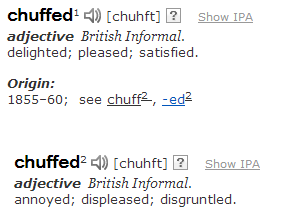
it means exactly what i think it means its just some stupid word that literally has two definitions that mean the opposite thing
what the hell
This makes me really chuffed
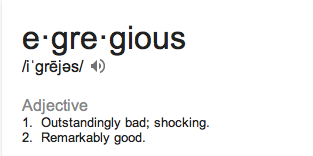
This post is quite egregious
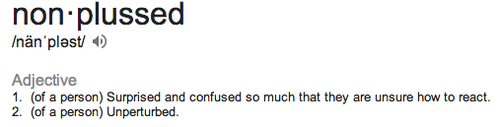
Well I’m nonplussed by this whole post.
goddamnit.
all of you go to hell
And you wonder why i am boggled at times
These are called contronyms! A word that is its own opposite.
Why the fuck do these exist
One theory is that the sarcastic use of the word became exceedingly prevalent and because another dictionary definition.
Are you telling me that we were such sarcastic shits it literally changed our language.
Don’t forget inflammable

latin student gothic
- you are translating cicero. you have not yet made it through a full sentence even though you have been reading for nearly two hours. every time you think you have made progress, cicero throws in another rhetorical device to extend the passage. you find yourself lost in hyperbaton. you still have not found the verb. you do not think you ever will.
- you learn yet another usage of the ablative absolute and dutifully add it to the list of usages you already know. you have started to forget what the other cases are, but you are not sure they matter anymore. all is ablative. all is absolute.
- you have begun to pick up the speech patterns of this strange ancient language when you talk in your own. it is said that you use more passives and impersonal verbs. with these things having been spoken, you no longer sound like the person you once were. if this happens much longer, your friends and family will have forgotten the you who once spoke to them. your grades in translation have improved, though, so you do not mind too terribly.
- a bitter war emerges between two factions of those who study alongside you. they argue ceaselessly, shouting phrases such as ‘caecilius est in horto’ and ‘raeda est in fossa’ at each other. one side calls the other sextus molestus, thus destroying any possibility for peace while the rest of you look on in horror.
- every free thought in your mind gravitates towards the idea that carthage must be destroyed. you are not certain why. you have never been to carthage and, as far as you know, carthage was destroyed millennia ago and needs no further destruction. that does not stop the thoughts, though. you begin to write that carthage must be destroyed at the end of your essays, to say that carthage must be destroyed at the end of every conversation. soon afterwards, you find that the only food that appeals to you anymore is cabbage. your classmates look upon you with sadness. cato has your soul, now.
When you know 3 languages and every one of them uses different rules to format dialogue
“- I couldn’t be more confused
. », I said.
for chinese new year they get all these famous actors and comedians together and they do a lil show and one of the comedians was like “i was in a hotel in america once and there was a mouse in my room so i called reception except i forgot the english word for mouse so instead i said ‘you know tom and jerry? jerry is here’
jerry is here
my chinese teacher once shared this story in class about someone who went to the grocery to buy chicken, but they forgot the english word for it, so they grabbed an egg, went to the nearest sales lady and said “where’s the mother”
When I was a teenager, we went to Italy for the summer holidays. We are German, neither of us speaks more than a few words of Italian. That didn’t keep my family from always referring to me when they wanted something translated because “You’re so good with languages and you took Latin”. (I told them a hundred times I couldn’t order ice cream in Latin, they ignored that.) Anyway, my dad really loved a certain cheese there, made from sheep’s milk. He knew the Italian word for ‘cheese’ – formaggio – and he knew how to say ‘please’. And he had already spotted a little shop that sold the cheese. He asked me what ‘sheep’ was in Italian, and of course, I had no idea. So he just shrugged and said “I’ll manage” and went into the shop. 5 mins later, he comes out with a little bag, obviously very pleased with himself.
How did he manage it? He had gone in and said “’Baaaah’ formaggio, prego.”I was done for the day.
This makes me feel better about every conversation I had in both Rome and Ghent.
I once lost my husband in the ruins of a French castle on a mountain, and trotted around looking for him in increasing desperation. “Have you seen my husband?” I asked some French people, having forgotten all descriptive words. “He is small, and English. His hair is the color of bread.”
I did not find my husband in this way.
In rural France it is apparently Known that one brings one’s own shopping bags to the grocery store. I was a visitor and had not been briefed and had no shopping bag. I saw that other people were able to conduct negotiations to purchase shopping bags, but I could not remember the word for “bag.”
“Can I have a box that is not a box,” I said.
The checkout lady looked extremely tired and said, “Un sac?” (A sack?)
Of course. A fucking sack. And so I did get a sack.
I once was at a German-American Church youth camp for two weeks and predictably, we spoke a whole lot of English.
When I phoned my mom during week two I tried to tell her that it was a bit cold in the sleeping bag at night. I stumbled around the word in German because for the love of god, I could remember the Germwn word for sleeping bag.
“Yeah so, it’s like a bag you sleep in at night?”
“And my mother must probably have thought I lost my mind. She just sighed and was like ‘So, a Schlafsack, yes?”
Which is LITERALLY Sleeping sac … The German word is a basically a one on one translation of the English word and I just… I failed it. At my mother tongue. BIG
My former boss is Italian and she ended up working in a lab where the common language was English. She once saw an insect running through the lab and she went to tell her colleagues. She remembered it was the name of a famous English band so she barged in the office yelling there was a rolling stone in the lab…
I’m Spanish and have been living in the UK for a while now. I recently changed jobs and moved to a new office which is lost somewhere in the Midlands’ countryside. It’s a pretty quaint location, surrounded by forest on pretty much all sides, and with nice grounds… full of pheasants. I was pretty shocked when I drove in and saw a fucking pheasant strolling across the road. Calm as you please.
That afternoon I met up with some friends and was talking about the new job, and the new office, and for the life of me I couldn’t remember the English word for pheasants. So I basically ended up bragging to my friends about “the very fancy chickens” we had outside the office.
Best thing is, everyone understood what I meant.
I love those stories so much…
Picture a Jewish American girl whose grasp of the Hebrew language comes from 10+ years of immersion in Biblical and liturgical Hebrew, not the modern language. Some words are identical, while others have significantly evolved.
She gets to Israel and is riding a bus for the very first time.
American: כמה ממון זה? (”How much money?” but in rather archaic language)
Bus Driver: שתי זוזים. (”Two zuzim” – a currency that’s been out of circulation for millenia)
that’s hilarious
I am officially screamlaughing at my desk from that last one OH MY
Words that Survived by Getting Fossilized in Idioms
- wend
You rarely see a “wend” without a “way.” You can wend your way through a crowd or down a hill, but no one wends to bed or to school. However, there was a time when English speakers would wend to all kinds of places. “Wend” was just another word for “go” in Old English. The past tense of “wend” was “went” and the past tense of “go” was “gaed.” People used both until the 15th century, when “go” became the preferred verb, except in the past tense where “went” hung on, leaving us with an outrageously irregular verb.- deserts
The “desert” from the phrase “just deserts” is not the dry and sandy kind, nor the sweet post-dinner kind. It comes from an Old French word for “deserve,” and it was used in English from the 13th century to mean “that which is deserved.” When you get your just deserts, you get your due. In some cases, that may mean you also get dessert, a word that comes from a later French borrowing.- eke
If we see “eke” at all these days, it’s when we “eke out” a living, but it comes from an old verb meaning to add, supplement, or grow. It’s the same word that gave us “eke-name” for “additional name,” which later, through misanalysis of “an eke-name” became “nickname.”- sleight
“Sleight of hand” is one tricky phrase. “Sleight” is often miswritten as “slight” and for good reason. Not only does the expression convey an image of light, nimble fingers, which fits well with the smallness implied by “slight,” but an alternate expression for the concept is “legerdemain,” from the French léger de main,“ literally, “light of hand.” “Sleight” comes from a different source, a Middle English word meaning “cunning” or “trickery.” It’s a wily little word that lives up to its name.- roughshod
Nowadays we see this word in the expression “to run/ride roughshod” over somebody or something, meaning to tyrannize or treat harshly. It came about as a way to describe the 17th century version of snow tires. A “rough-shod” horse had its shoes attached with protruding nail heads in order to get a better grip on slippery roads. It was great for keeping the horse on its feet, but not so great for anyone the horse might step on.- fro
The “fro” in “to and fro” is a fossilized remnant of a Northern English or Scottish way of pronouncing “from.” It was also part of other expressions that didn’t stick around, like “fro and till,” “to do fro” (to remove), and “of or fro” (for or against).- hue
The “hue” of “hue and cry,” the expression for the noisy clamor of a crowd, is not the same “hue” as the term we use for color. The color one comes from the Old English word híew, for “appearance.” This hue comes from the Old French hu or heu, which was basically an onomatopoeia, like “hoot.”- lurch
When you leave someone “in the lurch,” you leave them in a jam, in a difficult position. But while getting left in the lurch may leave you staggering around and feeling off-balance, the “lurch” in this expression has a different origin than the staggery one. The balance-related lurch comes from nautical vocabulary, while the lurch you get left in comes from an old French backgammon-style game called lourche. Lurch became a general term for the situation of beating your opponent by a huge score. By extension it came to stand for the state of getting the better of someone or cheating them.- umbrage
“Umbrage” comes from the Old French ombrage (shade, shadow), and it was once used to talk about actual shade from the sun. It took on various figurative meanings having to do with doubt and suspicion or the giving and taking of offense. To give umbrage was to offend someone, to “throw shade.” However, these days when we see the term “umbrage” at all, it is more likely to be because someone is taking, rather than giving it.- shrift
We might not know what a shrift is anymore, but we know we don’t want to get a short one. “Shrift” was a word for a confession, something it seems we might want to keep short, or a penance imposed by a priest, something we would definitely want to keep short. But the phrase “short shrift” came from the practice of allowing a little time for the condemned to make a confession before being executed. So in that context, shorter was not better.Holy shit, “giving umbrage” literally means “to throw shade”
þ!
A feature of English which I think is stupid,
If we’re carrying on with this game,
Is how we abolished the thorn and replaced it,
With two letters that meant the same.
The þ was a letter, amazing, astounding,
Perfect in every respect,
Representing the ‘th’ sound and shortening words,
The one thing it didn’t expect;
One day T and H went and burgled its meaning,
And then, thanks to the printing press,
Its symbol mutated and morphed into Y,
Which is pointless, I must confess.
Þoughtlessly, the þ was forgotten,
Þreatened as the language evolved,
Þankful for þose who knew of old English,
A topic where it was involved.
It only survived in Modern Icelandic,
In English it’s treated with scorn,
And as barely anyone knows it exists,
Please try to remember the thorn.
ð!
Saving the thorn from obscurity
Is surely a laudable aim
But if this letter deserves our praise
The eth should receive the same.The scribes of the Anglo-Saxons
interchanged the eth and thorn
until the first one fell from use
and the second was left forlorn,But for the modern Icelander
their roles are more defined
and could improve our English texts
if we were so inclined.The thorn (Þ, þ) denotes a voiceless dental fricative
as in the English ‘think’ or ‘thresh’ but not the ‘th’ in ‘hither,’
whereas the eth (Ð, ð) is a voiced dental fricative
perfect for ‘this’ and ‘that’ and most especially for ‘thither.’So I propose ðey boþ be used
in the Icelandic manner;
ðen students won’t be loaþ to learn
our spelling and our grammar.To þink we’ve never fixed ðis mess
is really quite astounding.
One letter cluster for two sounds?
Ðat’s damnably confounding!Þank you for ðis informative post!
Calm down, Feanor
english: coconut oil
french: 🙂
english: oh boy
french: oil of the nut of the coco
IM CRYINGNFN
english: ninety-nine
french: 🙂
english: oh no
french: four-twenty-ten-nine
english: potato
french: 🙂
english: oh geez
french: apple of the earth
french: papillon
english: 🙂
french: don’t
english: beurremouche
French: pamplemousse
English: 🙂
French: pls no
English: raisinfruitenglish: squirrel
german: 🙂
english: oh dear
german: oak croissant
english: helicopter
german: 🙂
english: uh oh
german: lifting screwdriver
english: toes
spanish: 🙂
english: no don’t
spanish
: fingers of the feet
english: ladybug
russian: 🙂
english: oh no
russian: god’s cow
english: shark
maltese: 🙂
english: pls no
maltese: sea dog
English: leopard
Dutch: 🙂
English: stop
Dutch: lazy horse
English: glove
German: 🙂
English: what now
German: hand shoe
English: dragon
Finnish: 🙂
English: no stop
Finnish: salmon snake
So I found this cool website for learning ancient languages
go wild
holy fuck
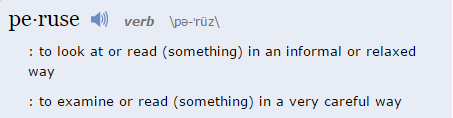
I just did a quick perusal of the Coptic resources on this site, and it has all the resources I’ve personally found worthwhile and then some. These are resources that took me months, if not years, to discover and compile. I am thoroughly impressed. The other languages featured on the site are:
- Akkadian
- Arabic
- Aramaic
- Church Slavonic
- Egyptian (hieroglyphics and Demotic)
- Elamite
- Ethiopic (Ge’ez)
- Etruscan
- Gaulish
- Georgian
- Gothic
- Greek
- Hebrew
- Hittite
- Latin
- Mayan (various related languages/dialects)
- Old Chinese
- Old English
- Old French
- Old Frisian
- Old High German
- Old Irish
- Old Norse
- Old Persian
- Old Turkic
- Sanskrit
- Sumerian
- Syriac
- Ugaritic
For the love of all the gods, if you ever wanted to learn any of these languages, use this site.
Likely helpful for various recon-oriented polytheists.
Please respect everyone’s choice of languages
Respect non-English speakers who want to learn English, instead of an obscure dialect in their country, because it will help them with global communication.
Respect people who want to learn their country’s dialects, because they want to preserve their country’s culture.
Respect people who want to do both.
Respect people who learn languages close to their native tongue, because they like it.
Respect people who focus on a single family of languages because they love those languages.
Respect people who want to learn diverse languages.
Respect people who only focus on Indo-European languages because of their own origins.
Respect people who are not interested in Indo-European languages.
Respect people who only want to learn one language.
Respect people who want to learn as many languages as they can.
Respect people who want to learn “mainstream” languages because it brings them joy.
Respect people who want to learn a language that feels easy to them because they love languages but are not very good students.
Respect people who want to learn any language for any reason.
Respect people’s choices when it comes to languages, because it is a deeply personal choice, and it shouldn’t be dictated by other’s opinion or by social justice.
And don’t make fun of people for not speaking your language. One of my roomies (I live in Denmark) speaks 6 languages, but people make fun of him for not speaking perfect Danish. And he’s lived in Denmark for only two years!
Also respect people who aren’t learning another language??? Kids at my sister’s school act like it’s a sin she’s not taking a language when English is hard for her as her mother tongue with her auditory processing disorder.
And one of the most difficult things to learn is correct pronounciation, especially if you’re not living in a country where that language is spoken, so please don’t make fun of people for that. Correct them if they don’t mind, but for heaven’s sake don’t laugh at them. (Someone did that because apparently the way I said “colored” was just so funny and it just discouraged me from speaking in English to them, because it’s not like I had to.)
Also if you didn’t understand someone because they don’t speak the language perfectly, ask them to repeat it in a normal way, without acting like they’re a) deaf, or b) their accent is the most horrible thing you’ve ever heard.
 radiantanor.home.blog