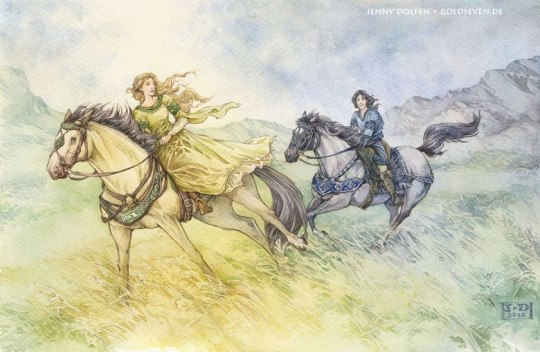
Éowyn and Faramir. Watercolour on Legion Stonehenge cold pressed paper, 21×31 cm.
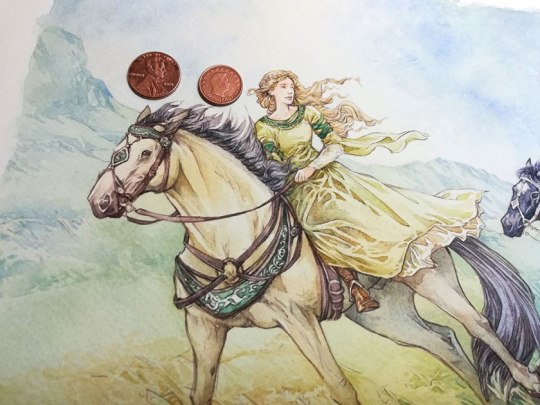
By coincidence, I found that I owned an American cent, and realised that it was way larger than the Euro cents I’m used to – here they are side by side.
Doing any sort of small detail is still incredibly hard for me, and I pay for it with headaches and having to paint in little half-hour instalments over several…
im gonna redraw this one day but yknow,, that scene from the return of the king
((click bc tumblr quality suckss))
Tame a strong woman? Ex-fucking-cuse you? I would break his balls right then and there.
I can’t believe there are people on tumblr dense enough to think that Tolkien wasn’t sexist.
You realize that Eowyn is LITERALLY calling out Gondorians for their enormous superiority complex by joking about it. You realize she’s basically saying “all of your frivolous court will never shut up about us because they look down on my people. One of you should never marry one of me, according to them.” Eowyn is LITERALLY LISTING THE STEREOTYPES the Gondorian gossip machine will produce.
Faramir is playing along. By saying to Eowyn: “I would.” he’s not saying- “yes I want them to hype my own ego.” Instead he’s saying: “Let them talk, I don’t care about what people are going to say because I love you”. Not only is he, through these two words acknowledging the Gondorian elites are classist and snobby but he’s saying they can all sod off. Faramir and Eowyn can communicate in sarcasm and cryptic phrases because they are so in tune they will understand the nuances in what the other is saying.
The book LITERALLY SAYS that when Faramir kisses her he “cared not that they stood high upon the walls in the sight of many.” He doesn’t care what people are going to say about them because he loves her that much.
This little piece of dialogue shows us 1. Tolkien is acknowleding his world has a Gondorian-Rohan hierarchal structure and is making sure this is addressed so we are safe in the knowledge Eowyn will not end up in a sucky hierarchal marriage 2. Faramir loves her so much he would GLADLY undergo the gossip machine and all it’s associated baggage 3. They are so in tune they can communicate these thoughts in two words. We are assured theirs will be a happy marriage.
If you want to be ugly about this couple would you mind not doing it on this comic I spent over 24 hours lovingly creating? Thanks.
And again she looked at Faramir. ’No longer do I desire to be a queen,’ she said.
Then Faramir laughed merrily. ’That is well,’ he said; ’for I am not a king. Yet I will wed with the White Lady of Rohan, if it be her will. And if she will, then let us cross the River and in happier days let us dwell in fair Ithilien and there make a garden. All things will grow with joy there, if the White Lady comes.’
The change to Faramir’s character in The Two Towers was by far my biggest disappointment with the movies. I discussed it with other fans back in the day, watched and rewatched the BTS features and listened to the commentary tracks, and ended up mostly defending the filmmakers’ decision in online debates. But it was always a little (or more than a little) sad for me that they did that.
I know the arguments on both sides. I know why they felt they had to do it. No one is giving me hundreds of millions of dollars to adapt a sprawling, multi-book epic to the big screen in a way that will justify its enormous budget and satisfy everyone from lifelong lovers of the source material (*waves*) to new fans and casual “eh, sure; I’ll watch it” types.
But I’ll always regret that they couldn’t find room for the actual character from the books, the one who wasn’t going to undercut Aragorn or his struggle just by existing, but also wasn’t going to beat up Gollum or send the Ring to Denethor, because those things were wrong, and he saw himself as bound by that.
There’s a clip of David Wenham describing how he went to Jackson/Boyens/Walsh (or maybe it was just a story recounted by one of the latter trio; I can’t remember now) after he’d read the books (which he hadn’t when he was cast), and saying hey, you know, this actually seems like a significant change to my character. And them telling him yeah, we know, but we need to for all these reasons (*enumerates reasons*) and anyway he ends up in the same place, right?
Yeah, no. I mean yeah, he ends up having made the same decision. But he’s not the same person. How he gets there matters.
I want to believe a movie could have been made that didn’t sacrifice his character in the name of storytelling. It wouldn’t have been the same movie; might not have been as successful a movie. But I would have loved it.
I’ve mentioned that I’m reading the books again, out loud with my co-conspirator at night, the way we used to do. We just finished the Council of Elrond, and it was a thrill to realize that the brother Boromir referred to (though not by name) was the real Faramir, my Faramir.
(Note: I do not like Faramir in the movies, and this is mostly an exploration of their differences from that perspective. I tried to avoid bashing, but eh. It’s also really long, much longer than I originally expected. You can watch/listen to the whole thing here.)
–
I think I’ve finally–after all these years–had an epiphany about movie Faramir vs. book Faramir. How the discussions generally seem to go is this:
Faramir = nice and mild, thus where movie Faramir = nice and mild, movie Faramir = book Faramir. Where movie Faramir comes across as morally unjust, movie Faramir not only isn’t book Faramir, but falls outside the acceptable range of Faramirness. These unacceptable breaks are regarded as lapses in his character, inconsistencies between mostly-like-Faramir and not-at-all-like-Faramir.
On the other hand, if we look at movie Faramir’s character as a whole, I think two critical traits emerge. One, he’s generally accommodating, good-natured, and conflict-averse (not willful or independent; also not scholarly or otherworldly). Two, he’s overpoweringly driven by the desire to earn the affection and approval of his father–it defines who he is in a very large part, and is his overriding motivation for everything.
It’s not that he’s ‘not exactly like book Faramir,’ but rather, exactly what his defenders always said: he’s a different person. He doesn’t have OOC lapses now and then; his personality is radically, and consistently, different.



 radiantanor.home.blog