if i had to get in a fistfight with any member of the fellowship it would be Frodo because i would easily win
all i am saying is that he would ostensibly be the easiest one to take on in a fight given that he’s like three feet tall and has led a life of (physical) leisure compared to all of the others due to his standing as a gentlehobbit
legolas, aragorn, and gimli are all used to combat, sam works as a gardener, merry and pippin often gallivant off and get into mischief so they have the advantage of experience in whatever it is they’ve gotten up to/would possibly fight dirty, gandalf is gandalf so while weapons are out of the question i suppose that depends on if magic is involved. i don’t think i could take him without magic even if he IS old because he’s a very large guy, but maybe
it would be my knuckles against Frodo’s baby soft poet hands, plus i’ve got the additional height and fighting experience. i just think that he would be the easiest to win against in hand-to-hand combat out of the rest of them. also he isn’t real so he can’t offer a rebuttal to my claim
you’re absolutely correct BUT wanting to fight Frodo makes you a monster D:
this has nothing to do with WANTING to fight Frodo, i just think he would be easiest for me to beat in a fight with no weapons. unless he utilized his very large feet, but i think he’s too polite to do that because it’s a fist fight and that would be considered playing dirty
for someone who doesn’t want to fight Frodo you sure have put a lot of thought into fighting Frodo……….
OP is wrong though: you fight Pippin.
First off, Pippin has it coming, so you won’t be fighting your conscience at the same time.
Secondly, Pippin is a spoiled rich kid. He’s no less gentry than Frodo is, but Frodo works out and is shown to have better stamina, at least at the outset. Pippin is also both the stupidest and the slowest of the hobbits. They both nearly beat one (1) troll, so that’s comparable, but Pippin appears not to have got a single hit in against the orcs that captured them while Merry was cutting off hands like a boss. Pippin also straight-up tell Bergil that he’s not a fighter.
Also there’s a nonzero chance that Frodo will just straight up curse you (if the guilt of fighting Frodo isn’t enough if a curse by itself).
And, of course, if you try to fight Frodo, you will 100% end up fighting Sam, and he will wreck you (and you’ll deserve it, you monster)
Also: if you fight Frodo you’ll have a very angry Sam & possibly also the entire Fellowship to deal with BUT if you fight Pippin they will probably cheer you on.
Bold of you to assume one could attempt to fight Pippin and NOT instantly be killed by Boromir.
So here’s the thing – you absolutely DO NOT want to try and fight Frodo or Pippin because they are going to be protected by the rest of the Fellowship, which basically exists to stop asshole Big People from picking on the hobbits. Folk might talk a big game but when the chips are down, you are not going to lay a single hand on any of the hobbits. Either you’ll find yourself immediately fighting all four of them or else you’ll move to land your first hit and suddenly Aragorn will side-tackle you into the trees. And he probably hits like a freight train tbh.
So here’s what you do:
You fight Legolas.
The thing about fist-fighting Legolas of course is that you will lose. This is not a fight you’re gonna win no matter what. But Legolas has his standing competition with Gimli, so once the challenge is issued, he’s not gonna let anyone else step in and fight you either. No one is liable to volunteer on his behalf, either, so you will only end up fighting the one member of the fellowship. If you are lucky he might also take his shirt off. Bonus!
Anyway.
Legolas will mop the floor with you, but he’s also already convinced you’re weaker than him anyway because you’re not an elf, so he’s gonna go kind of easy on you. And when you lose he will be all snide and superior about it, which means everyone in the fellowship is gonna sympathize with you, and Gimli will probably challenge him on your behalf afterwards, but here’s the key thing:
You will have lost a fist-fight to an immortal warrior prince.
That’s a way better loss to cop to than that time you tried to fistfight a pudgy gentlehobbit and got beaten to the point of unconsciousness by his gardener, yeah?
okay so tolkien tumblr is fast becoming my fave tumblr community thank you thank you all you are the true fellowship here.
here is a concept that I’m still trying to flesh out: medieval science fiction.
not, of course, aliens land during the middle ages, though I’ve read and enjoyed that, but something much more difficult to execute, if it’s possible at all: space opera (exempli gratia) as written by Bede or Gildas or Geoffrey of Monmouth.
The challenge is, of course, that you have to get into the medieval mind (ok, I know that talking about “the” medieval mind is fallacious) and figure out what they’d keep from their world and what they’d think to change – what is the analogue to ‘50s writers giving us faster than light travel & radioactive planets & psionics and still having gender and family politics that are identical to ‘50s middle class American politics? I have a feeling it’s the Church – it’s true that there are several books with Space Popes, but it tends to be a rebirth of the Papacy. I doubt a medieval science fiction writer would have the Church decline or even guess at the Reformation.
Also, sci-fi tech tends to be, both aesthetically and functionally, an extension of tech the society it’s from already has – does a medieval space ship look like a siege tower? How do they envision the instant communication I’m sure they’d have to have as working? Would it be through magic (which is often the case in modern sci-fi)?
And what would the spirit of it be? I would argue that, while you can’t really generalize over an entire field, and there is certainly some bleak sci-fi, the general tenor of American sci-fi is hopeful & enamored of the human spirit. Is the point of medieval space travel to find God*? Will leaving Earth leave behind Original Sin? Are we going to convert the Martians?
DO they need instant communication? I mean, even star wars still has people carrying thumb drives around. There could be a pigeon analogue – sleek little machines flitting between the stars carrying messages, or perhaps creatures already native to the higher spheres suited to the task. Venusian swallowtails, mercurial spirits.
I’d love to see the heavenly spheres as a setting for this all on its own, too. What’s the first moment a traveler hears the music like?
I could see a lot of it through the lens of knights on impossible quests – why not ascend the sky? Knights riding on bright steeds of golden fire known as comets. Knights finding allegorical realms on the various planets, like the Kingdom of Love from Capellanus’ Treatise on The Arts of Courtly Love, but set in the golden mountains of Venus, and you could have a Kingdom of War and a Kingdom of Wit and a Kingdom of Time on Mercury and Mars and Saturn. Prester John could be from Jupiter!
I’m not sure about the ways I would expect medieval scifi to be subversive, but I might look at Marie de France for ideas, she plays a lot with expectation and obligation and the implications of gender in her Lais, in very clever ways.
medievals didn’t have the concept of vacuum, let alone know that space doesn’t have air. everything is open ships and space sails. gravity isn’t oriented to the planet, there’s a universal ‘down’. engines are driven by people or animals or wind or water, not burning fuel; your space chariot is pulled by cloud horses or sun lions.
other planets are not other earths, they’re allegorical locations populated by allegorical creatures. angels, demons, dreamers, cannibals, a planet of all women and a planet of all men – but not for 1950′s bikini shenanigans, more as a parable about how the sexes can’t get along without each other because men’s work and women’s work are both necessary. no concept that men could do women’s work and vice-versa, or at least do it competently. the men on the men’s planet would like, grow children in their fields, but wean them on burnt bread soaked in beer because they’re terrible at milking cows and kneading dough, or something like that.
there’s a Renaissance thing, Orlando Furioso, in which the knight Astolfo gets to the moon in Elijah’s burning chariot. (He goes to the moon because everything that has been lost on Earth can be found there, including Orlando’s sanity, because of course.)
I think I’d argue that theological allegory, like the Divine Comedy or the Vision of Piers Plowman, pretty much is medieval science fiction: speculations and warnings and encouragement, based on what is known-or-believed-to-be-known. As I understand it, the general opinion of medieval European scholars was that theology was THE most important thing to know about; studying the Creator more fervently than the creation was considered pretty much the same degree of Obviously Sensible as, say, studying birds doing bird things and being birds instead of just looking at empty nests and eggshells would be to us, like, why study mere side-effects when you can study The Entire Truth And Cause Of Everything? So I would argue that theology is the medieval version of twentieth century rocket science and atomic physics as The Coolest Thing To Know About, and thus spec fic based on it is the equivalent of science fiction.
You guys might enjoy a book I remember reading ages ago…Richard Garfinkle’s Celestial Matters. I honestly can’t remember whether I liked it or not, but it’s basically “What if ancient astronomy was totally legit? Okay, adventure time.”
And, going in the opposite direction, for a modern example of someone writing in the style of a medieval travelogue but as if it were true science, check out Umberto Eco’s Baudolino. If you love history and sly wit, Eco’s your man.
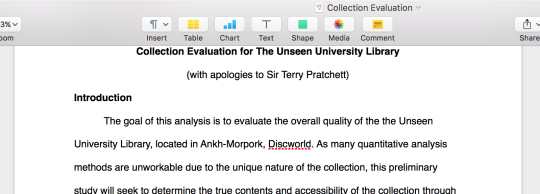
She doesn’t know it yet, but she will soon. You see, the midterm paper on calls for students to write a collection evaluation for a library of our choosing. Now, I know that when she said that library does not need to be real, she meant that we didn’t need to pick a specific one. But what I heard was…
For those of you requesting the full paper, I’ll see what I can do once I get the grade back!
I’M SO GLAD YOU ASKED
For the sake of this evaluation, only the official, present collection of the Unseen University will be examined. Collections belonging to other libraries that are accessible via L-Space will be considered as part of the Interlibrary Loan System, as will materials available by time-travel and other such means.
Relatedly:
Whether or not acquiring books that have not yet been written is a violation of copyright law has yet to be legally clarified, but faculty and students should not expect to be permitted to cite them in their own work (see also Library Rule 3: Do Not Interfere With The Nature Of Causality).
So here’s something
weird: why did Míriel and Pharazôn marry so late? They were 138 and
137 (respectively) at their marriage, however Palantír was 82 when
Míriel was born and Gimilkhâd 74 when Pharazôn was born, which
meant they would have been married when they were no later than 81 or
73 (again respectively).
Looking at
the line of kings from when they changed to having names in Adûnaic,
none of those kings’ first children were born to a king over 100:
Adûnakhôr was 89 when his eldest son was born, Zimrathôn 78,
Sakalthôr 84, and Gimilzôr 75. They all certainly would have been
married by then, so their age at marriage would probably be in their
late 60s to late 70s.
And yet both Míriel
and Pharazôn went unmarried for twice as long. This is particularly
strange considering their expected lifespan: Sakalthôr, Gimilzôr,
and Palantír all died in their early 200s, and Gimilkhâd was 199 at
his death, so Míriel and Pharazôn probably only had another 80
years of life at most when they finally married/were forced to marry.
Míriel’s case in
particular is strange. You could posit that Pharazôn wanted to
postpone his marriage because he planned to marry Míriel and take
over the kingship, as did happen (though it would probably would have
been Gimilkhâd’s idea originally). But Míriel should have married
earlier, for both political and dynastic reasons. Even if she and
Palantír (and Inzilbêth) were worried about a Vanimelde
situation, it’s hard to believe that particular risk would outweigh the benefits. It’s possible that Palantír’s father Gimilzôr
forbade Míriel’s marriage to a suitable candidate during his lifetime, but that shouldn’t
have affected what Míriel did once her father took the throne. And
frankly, Pharazôn not marrying made Míriel’s political future even
more at risk. Perhaps Míriel had a childless first marriage and
was a widow when Pharazôn forced her to marry, but I rather think
that would be mentioned?
Anyways, there was
probably some really interesting politicking going on in Gimilzôr
and Palantír’s courts, and that’s the only conclusion I feel able to draw from this.
Manwë: Dwarves do not belong in Valinor. We need to get him back to Middle Earth.
Aulë: *wraps arms around Gimli protectively* Oh yeah? Good luck finishing the street lights for Valmar by yourself. Also, I hope you know how to make yourself a new diadem. Generally good luck with all metalwork, cause I’m out of here.
Manwë: I’ll hire Elven smiths *looks at Elven smiths*
Mahtan: Don’t look at me, I’m with Aulë.
Fëanor: Are you fucking serious right now Manwë
Nerdanel: You made the little guy upset, go away.
Curufin: Lol bye.
Celebrimbor: Sorry, I don’t speak Dwarf haterish.
Rog: What are you gonna do? Enslave me like your brother did?
Everybody talks about Anastasia, which is a shame, because it’s a far less interesting example of Russian fake heir drama than that whole business with the False Dmitries.
Okay, so Ivan the Terrible’s youngest son,
Dmitry, was assassinated in 1591 at the age of 8. Fast-forward nine years, and there’s a guy going about Eastern Europe claiming that he is Dmitry, having secretly escaped the assassination attempt and lived in hiding under a false identity ever since. This sort of business isn’t too unusual, but this guy actually pulls it off, managing to gain the Russian throne and rule for nearly eleven months before being dragged from the palace and publicly executed in early 1606. He’d subsequently go down in history as False Dmitry I.
Here’s where it gets interesting. In mid 1607, a second impostor declares himself. Bizarrely, this one doesn’t dispute the first impostor’s legitimacy; instead, he claims to be the same guy, having miraculously survived his apparent execution the year before. He somehow wins the political support of False Dmitry I’s widow, and with her vouching for his identity, he gains the allegiance of the Cossacks, rallies an army over 100 000 strong, and tries to “take back” the throne. Though his march on Moscow ultimately failed, he successfully conquered most of Southeastern Russia, which he would rule until his untimely death in December of 1610, when he was beheaded in a drunken altercation with a Tartar prince. The history books know him as False Dmitry II.
Now jump ahead three months to March of 1611, when a third fucking impostor pops up. Dude apparently just magically appeared from behind a waterfall in goddamn Ivangorod and declared himself Tsar. Following the lead of False Dmitry II, he doesn’t dispute either of the two previous impostors, instead claiming some sort of spiritual reincarnation and/or magical resurrection – it’s not entirely clear which – to establish himself as the same guy. He must have talked a good game, because he managed to win the support of the same fucking Cossacks who supported False Dmitry II’s claim. Unfortunately, he was a far less able commander, being forced to flee his stronghold only a year later, whereupon he was spirited away to Moscow and secretly executed. Though he never managed to actually rule anything, historians decided to stick to the theme and dubbed him False Dmitry III.
At this point the historical record becomes confused, with some sources asserting there was a fourth False Dmitry, though others insist that the third False Dmitry was simply counted twice due to poor record-keeping. Still, whether we’re talking about three False Dmitries or four, imagine the whole mess from the Tsar’s perspective. Dude just wouldn’t stay dead!
ohh you missed one of my favorite bits.
False Dmitry I not only was executed, it was KNOWN he was fake. Powers that be used him until he was trouble, and THEN executed him.
Then quartered him.
Then cremated what was left.
Stuffed the ashes in a can.
And shot him out of a cannon back towards Poland, where he actually came from.
«…then Morgoth shall come back through the Door out of the Timeless Night; and he shall destroy the Sun and the Moon, but Earendel shall come upon him as a white flame and drive him from the airs…»
Remember Gorlim, and in particular how he is remembered as “the Unhappy”?
Beren was the only survivor of his dad’s heroic last stand group, and the only one to see the “wraith of Gorlim” and receive his warning. Which means he must have been the one who relayed that part of the story to the Elves or other Edain, who then wrote songs and histories about it. Given the detailed description of Gorlim’s backstory, his reasons for the betrayal and the emphasis on the mitigating circumstances, the most likely in-universe explanation is that Beren made sure he would be viewed sympathetically.
“The Unhappy” is not a positive epithet, of course, but it’s a lot more flattering than some of the other possibilities. Gorlim is a far more sympathetic
character than other notable traitors like Maeglin or Grima, and I know it’s because he actually was a better person. But in-universe, the main reason anyone would know all that has to be Beren’s decision to tell his story this way, even though he lost the last of his family and companions because of that betrayal. Many people would not have been as kind to Gorlim’s memory in his place, even considering his obvious regret and the attempted post-mortem warning.




 radiantanor.home.blog